Category: Blog

  • Infrastructure-Led Budget 2026-27: A Growth Blueprint for Real Estate

    Infrastructure-Led Budget 2026-27: A Growth Blueprint for Real Estate

    The Union Budget 2026-27 lays out a clear roadmap for infrastructure-driven economic expansion. While it does not introduce major direct tax incentives for homebuyers, it creates a strong foundation for long-term growth across India’s real estate sector.

    By increasing capital expenditure, promoting manufacturing, strengthening Tier-2 and Tier-3 cities, and supporting tourism and digital infrastructure, the Budget positions real estate as a key beneficiary of broader economic development. Let’s take a closer look at how these measures could shape the future of residential, commercial, industrial, and hospitality real estate in India.

    Higher Capital Expenditure: Laying the Groundwork for Growth

    One of the biggest highlights of the Budget is the continued push for public capital expenditure. Infrastructure outlay has been increased to Rs.12.2 lakh crore, up from Rs.11.2 lakh crore in FY 2025–26. This sustained investment in roads, railways, urban transport, and public infrastructure is expected to unlock new real estate growth corridors. Historically, improved connectivity has led to higher land values and faster development in surrounding areas. The same trend is likely to continue as new transport networks and urban projects take shape.

    For developers and investors, this means opportunities beyond traditional metropolitan cities. As connectivity improves, peripheral areas and emerging markets could see stronger residential and commercial demand.

    Focus on Tier-2 and Tier-3 Cities

    The Budget gives special attention to Tier-2 and Tier-3 cities, especially those with populations exceeding five lakh. These cities are increasingly becoming economic hubs due to lower costs, improving infrastructure, and growing job opportunities.

    By strengthening urban infrastructure in these regions, the government aims to support balanced economic development. For the real estate sector, this could translate into:

    • Rising demand for mid-income housing
    • Growth in office spaces and co-working hubs
    • Expansion of retail and hospitality projects
    • Increased industrial and warehousing development

    As businesses move beyond major metros in search of cost efficiencies, real estate in smaller cities may experience sustained growth over the coming years.

    High-Speed Rail and City Economic Regions

    A major proposal in the Budget is the development of seven high-speed rail corridors connecting key urban and economic centers. Better inter-city mobility can significantly impact property markets by reducing travel time and making satellite towns more attractive. In addition, the creation of City Economic Regions (CERs) across Tier-2 and Tier-3 cities is a transformative step. Each CER will receive investments of Rs.5,000 crore over five years to upgrade infrastructure and strengthen economic ecosystems.

    These initiatives are likely to:

    • Boost real estate demand along new rail routes
    • Accelerate growth in peripheral micro-markets
    • Increase investor interest in emerging regional hubs

    Improved connectivity often acts as a catalyst for residential townships, business parks, and retail centers.

    Encouraging Private Participation and REIT Growth

    The Budget proposes measures such as an Infrastructure Risk Guarantee Fund to encourage private sector participation in infrastructure projects. This can reduce risks for investors and attract more institutional capital.

    Continued monetisation of CPSE (Central Public Sector Enterprise) real estate assets through REIT structures is another positive step. Real Estate Investment Trusts (REITs) have already gained traction in India, and increased supply of quality assets can deepen the market.

    For investors, this means improved liquidity and greater transparency in the real estate ecosystem.

    Manufacturing Push: Boost for Industrial and Logistics Real Estate

    A strong focus on manufacturing is another key pillar of the Budget. Sectors such as biopharma, electronics, chemicals, textiles, rare earths, and construction equipment are set to receive policy support. As manufacturing expands, demand for industrial land, warehousing, logistics parks, and R&D facilities is expected to grow. The development of plug-and-play industrial parks and revitalisation of older industrial clusters can further accelerate this trend.

    This has several implications:

    • Increased demand for logistics hubs near highways and ports
    • Growth in Grade-A warehousing facilities
    • Expansion of industrial corridors
    • Rising need for worker housing in manufacturing clusters

    Over time, a stronger manufacturing base can also drive residential and retail demand in surrounding areas.

    Tourism-Led Development and Hospitality Growth

    The Budget highlights tourism as a driver of economic growth, with focus areas including healthcare, heritage, and eco-tourism.

    Key proposals include:

    • Establishment of five regional medical hubs
    • Development of 15 archaeological and heritage sites as experiential destinations
    • Creation of Buddhist circuits in the North-Eastern states

    Such initiatives can significantly benefit the hospitality sector. Hotels, serviced apartments, resorts, and retail developments near tourist destinations may see rising demand. Healthcare-focused tourism can also create opportunities for medical office spaces and supporting infrastructure.

    For regions with cultural and natural attractions, these measures could stimulate long-term hospitality-led development.

    Tax Reforms and Investor Confidence

    Although the Budget does not introduce major new housing tax incentives, it focuses on creating a predictable, rules-based tax regime. Efforts to resolve procedural bottlenecks and transfer pricing disputes can enhance investor confidence.

    Foreign investors, in particular, may benefit from greater clarity and stability in taxation policies. Lower regulatory uncertainty often reduces risk premiums and improves capital inflows into real estate and infrastructure.

    Data Centers and Digital Infrastructure

    A notable announcement relates to tax clarity for foreign cloud service providers procuring data center services from India. Eligible cloud-related income will remain non-taxable until 2047, providing long-term certainty. Additionally, a 15% on-cost safe harbor margin for Indian data center entities servicing overseas affiliates strengthens India’s competitiveness in hyperscale infrastructure.

    These measures are likely to:

    • Attract global technology players
    • Encourage new data center investments
    • Drive demand for land and power infrastructure

    With digital consumption growing rapidly, data centers are emerging as a new and important real estate asset class.

    Simplified Tax Compliance for Property Buyers

    The Budget also eases tax compliance for resident buyers purchasing property from non-residents. The removal of the requirement to obtain a Tax Deduction and Collection Account Number (TAN), allowing TDS deposits through PAN instead, simplifies cross-border property transactions.

    This move reduces paperwork and administrative delays, making transactions smoother for buyers and sellers alike.

    Conclusion: A Strong Structural Foundation

    Overall, the Union Budget 2026-27 positions real estate as a downstream beneficiary of infrastructure-led growth. While immediate stimulus for residential demand may be limited, the long-term structural measures are significant. Higher capital expenditure, support for Tier-2 and Tier-3 cities, manufacturing expansion, tourism development, digital infrastructure incentives, and improved tax clarity together create a supportive ecosystem.

    For developers, investors, and homebuyers, the message is clear: the real estate sector’s growth story will increasingly be driven by infrastructure, connectivity, and regional economic development. Over time, this approach can lead to more balanced, diversified, and sustainable expansion across India’s property markets.

    Keep reading Inframantra blogs and articles for more such insightful content. To explore the best properties in Gurgaon, Noida, Delhi, Pune, and Jaipur, visit Inframantra website. Inframantra is one of the best real estate consultancy firms in Gurgaon that offers best properties developed by the top real estate developers of the city. Enjoy end-to-end assistance with top-notch home-buying services without having to pay any brokerage. Connect today! 

  • Experience 5-Star Living at Whiteland The Westin Residences Gurgaon

    Experience 5-Star Living at Whiteland The Westin Residences Gurgaon

    Luxury living in Gurgaon has reached a new benchmark with Whiteland The Westin Residences, Sector 103, Dwarka Expressway. As the first Westin Branded Residences in India, this iconic development blends world-class hospitality with ultra-premium residential design. Strategically located in the heart of Dwarka Expressway, this landmark project offers exclusivity, sophistication, and an elevated lifestyle curated by globally renowned experts.

    A Landmark Branded Residential Development in Gurgaon

    Whiteland The Westin Residences is not just another luxury housing project in Gurgaon, it is a hotel-managed branded residence that delivers the signature elegance and service excellence of Westin. Designed by internationally acclaimed architect Hafeez Contractor, with landscaping by Coopers Hill and interiors by Bobby Mukherji & Associates, the project embodies architectural brilliance and refined aesthetics.

    Spread across a massive 21-acre land parcel, the development features 13 iconic towers with G+42 floors, making it one of the most prestigious high-rise residential projects on Dwarka Expressway Gurgaon. The thoughtfully designed master plan ensures expansive open spaces, lush landscaped greens, and a resort-style environment that promotes wellness and tranquility.

    Premium 3BHK and 4BHK Residences with Expansive Layouts

    The project offers spacious 3BHK and 4BHK luxury apartments in Sector 103 Gurgaon, with unit sizes ranging from 2537 sq. ft. to 4112 sq. ft. Each residence is designed to maximize comfort, privacy, and natural light.

    Key highlights of the residences include:

    • Two master bedrooms in every apartment
    • Balcony-attached bedrooms with panoramic city and greenery views
    • Dedicated powder room
    • Large living and dining spaces ideal for entertaining
    • 65%–75% club-facing residences offering scenic views

    Every tower features a 48-foot-high grand entrance lobby, along with an exclusive entry and drop-off area, enhancing the sense of grandeur and privacy.

    Resort-Style Living with 5-Star Hotel Services

    One of the most distinctive aspects of The Westin Residences Gurgaon is its hotel-managed luxury lifestyle. Residents enjoy a curated hospitality experience backed by premium services typically found in a 5-star hotel. The development boasts a massive 1.75 lakh sq. ft. clubhouse, making it one of the largest in the region. Ultra-luxurious amenities include:

    • 3 multi-cuisine fine dining restaurants
    • Multiple swimming pools
    • 18 guest suites with 5-star hospitality services
    • Dedicated concierge services
    • Business lounge and meeting rooms
    • Landscaped gardens and wellness zones
    • Multi-tier security system

    The focus on holistic well-being makes it an ideal choice for modern families seeking comfort, convenience, and luxury in one address. From curated experiences to personalized services, every aspect of life here reflects premium living.

    Prime Location on Dwarka Expressway

    Location plays a crucial role in real estate investment, and Whiteland The Westin Residences Dwarka Expressway stands out for its unmatched connectivity.

    • Less than 30 minutes from IGI Airport
    • Just 15 minutes to the New Diplomatic Enclave
    • Only 12 minutes from Yashobhoomi Metro Station, Dwarka Sector 25
    • Approximately 33 minutes from DLF Cyber Hub
    • Close proximity to upcoming metro corridors

    Sector 103, Gurgaon, is rapidly emerging as a high-growth corridor, making this project not only a luxury address but also a promising real estate investment opportunity.

    A Rare Investment Opportunity in Branded Residences

    Branded residences have become a preferred asset class for luxury homebuyers and investors due to their premium positioning and high appreciation potential. As the first Westin Branded Residences in India, this development offers a rare opportunity to own a globally recognized lifestyle asset in Gurgaon’s most strategic location.

    With its architectural excellence, resort-style amenities, 5-star hospitality services, and strong connectivity, Whiteland The Westin Residences Sector 103 sets a new benchmark in luxury real estate on Dwarka Expressway. For those seeking exclusivity, comfort, and long-term value, this project delivers a living experience that truly stands apart.

    Would you like to take a site visit of Whiteland The Westin Residences Gurugram? If yes! Feel free to connect with an Inframantra property advisor to book and avail guided site visits to your preferred residential properties. Inframantra is one of the best real estate consultancy firms in Gurgaon that offers premium home-buying services without any brokerage. Connect with Inframantra today to start your home-buying journey.

    You may also like to read:-

    Is Whiteland The Aspen Worth Buying? Location, Price and Floor Plans

    Which are the best sectors on Dwarka Expressway and why?

  • TDR in Real Estate: Meaning, Process,Types and Benefits

    TDR in Real Estate: Meaning, Process,Types and Benefits

    Transfer of Development Rights (TDR) is an important concept in urban planning and real estate development in India. It allows landowners to transfer their unused development potential, commonly referred to as Floor Space Index (FSI), from one property to another. This mechanism ensures balanced urban growth while protecting environmentally sensitive, heritage, and reserved land.

    In simple terms, TDR in real estate provides compensation to landowners whose properties are restricted from construction due to public or environmental purposes.

    What is TDR in Real Estate?

    TDR stands for Transfer of Development Rights. It is a legal tool that allows a landowner to transfer the unused FSI of their land to another plot located in a designated receiving zone.

    For example, if a plot is reserved for road widening, a public park, metro construction, or falls under a heritage zone, the owner may not be allowed to construct on it. Instead of losing the land’s economic value, the municipal authority issues a TDR certificate equivalent to the unused development potential. This certificate can be sold to developers or used on another eligible property to construct additional built-up area beyond the base FSI limits. This system benefits both landowners and developers while supporting sustainable urban development.

    How Does TDR Work?

    The TDR process works through two main components:

    1. Sending Plot:

    This is the land from which development rights are transferred. It is usually reserved for public infrastructure, green zones, heritage protection, or other restricted uses.

    2. Receiving Plot:

    This is the land where additional FSI is allowed by utilizing the transferred development rights.

    By shifting development potential from restricted areas to growth corridors, TDR ensures structured city expansion without overburdening sensitive zones.

    Step-by-Step TDR Process in India

    Here’s how the TDR process in India typically works:

    Step 1: Identification of Eligible Land

    Urban local bodies or planning authorities identify land required for public projects such as roads, parks, sewage systems, or metro lines.

    Step 2: Voluntary Surrender of Land

    The landowner voluntarily surrenders the reserved land to the municipal authority without monetary compensation.

    Step 3: Issuance of TDR Certificate

    After verification and inspection, the authority issues a TDR certificate based on the permissible FSI of the surrendered land.

    Step 4: Sale or Transfer of TDR

    The landowner can sell the TDR certificate in the open market or transfer it to a developer.

    Step 5: Utilization in Receiving Zone

    Developers use the TDR to obtain additional FSI and increase construction area in approved receiving zones.

    Types of TDR in India

    Different types of TDR in India serve specific urban planning purposes:

    1. Urban TDR

    Used for redevelopment projects, slum rehabilitation, and decongesting crowded areas. It promotes urban renewal and organized city growth.

    2. Environmental TDR

    Encourages preservation of forests, wetlands, and eco-sensitive areas by compensating landowners with transferable rights instead of allowing construction.

    3. Heritage TDR

    Protects historical buildings and cultural landmarks by restricting redevelopment while offering development rights elsewhere.

    4. Infrastructure TDR

    Issued when land is acquired for public infrastructure such as highways, parks, metro lines, or drainage systems, reducing the financial burden on governments.

    Benefits of TDR in Real Estate

    The Transfer of Development Rights offers multiple economic, environmental, and social advantages:

    • Balanced Urban Development: Redirects construction to planned growth corridors, preventing overcrowding.
    • Environmental Protection: Preserves green belts and eco-sensitive areas while enabling sustainable development.
    • Economic Incentives for Landowners: Owners of restricted land receive financial value through sale of TDR certificates.
    • Developer Advantage: Developers gain access to additional FSI, allowing high-rise and mixed-use projects.
    • Infrastructure Growth: Facilitates public infrastructure development without immediate cash compensation from municipal bodies.
    • Heritage Conservation: Ensures preservation of culturally important buildings.
    • Transparency in Transactions: Many cities are digitizing TDR processes, improving traceability and reducing fraud.

    What is a TDR Certificate?

    A TDR certificate is an official document issued by a municipal authority that specifies the amount of transferable development rights granted to a landowner. It is measured in square meters of FSI and can be sold, transferred, or utilized in approved receiving areas.

    To obtain a TDR certificate, the landowner must:

    • Submit an application with ownership details
    • Surrender the reserved land
    • Undergo verification by authorities
    • Receive approval and issuance of the certificate

    Once issued, the certificate becomes a tradable asset in the real estate market.

    Conclusion

    Transfer of Development Rights (TDR) is a powerful urban planning tool that supports sustainable development in India. By allowing the transfer of unused FSI from restricted land to designated growth zones, TDR protects green spaces, heritage properties, and public infrastructure projects while ensuring economic value for landowners. Understanding what TDR is and how it works can help property owners, developers, and investors make informed real estate decisions in India’s evolving urban landscape.

    Keep reading Inframantra news, blogs, and articles for more such insightful content. If you wish to explore the best properties in your city, and avail the best home-buying services without having to pay any brokerage, visit Inframantra website. Inframantra is one of the best real estate consultancy firms in Gurgaon that brings to you the best properties developed by top real estate developers, in the prime locations of your city. Connect with an Inframantra property advisor today to start your home-buying journey. 

    You may also like to read:-

    What is PLC in Real Estate and How Does It Impact Property Prices?

    Real Estate Investment Trusts (REITs): Meaning, Types, and Investment Benefits

    Property Inspection Checklist: A Guide for Homebuyers and Investors

  • Freehold vs Leasehold Properties: A Simple Guide for Home Buyers

    Freehold vs Leasehold Properties: A Simple Guide for Home Buyers

    When buying a property in India, one of the most important legal aspects to understand is freehold vs leasehold property. Many property buyers focus on location, price, and amenities, but often overlook the ownership type. However, the difference between freehold and leasehold property can significantly impact your rights, resale value, loan approval, and long-term investment returns.

    In this guide, we break down everything you need to know about freehold property in India, leasehold property in India, and which option is better for you.

    What is Freehold Property?

    A freehold property means the buyer has complete ownership of both the property (house/flat) and the land it stands on. The ownership is permanent and can be transferred, sold, or inherited without time restrictions.

    Key Features of Freehold Property:

    • Full ownership of land and building
    • No time limit on ownership
    • Easier to sell or transfer
    • Higher resale value
    • Easily approved for property loans

    In India, most independent houses and many apartments are sold as freehold properties. Banks and financial institutions prefer financing freehold properties because they carry lower legal risk.

    Advantages of Freehold Property:

    • Complete control over the property
    • No ground rent or lease renewal charges
    • Better appreciation in value
    • Fewer legal complications

    Disadvantages:

    • Higher purchase price
    • Higher upfront investment

    What is Leasehold Property?

    A leasehold property means the buyer owns the property (house/flat) but not the land. The land belongs to a government authority, development authority (like DDA), or private landowner. The property is leased for a fixed period, usually 30, 60, 90, or 99 years.

    After the lease period ends, ownership rights may revert to the original landowner unless renewed.

    Key Features of Leasehold Property:

    • Ownership is valid for a fixed term
    • Annual ground rent may apply
    • Requires lease renewal after expiry
    • Restrictions on structural changes

    Leasehold properties are common in cities like Delhi (DDA flats), Mumbai, and certain cantonment areas.

    Advantages of Leasehold Property:

    • Lower initial purchase cost
    • Good option for short-term ownership
    • Available in prime urban locations

    Disadvantages:

    • Lease renewal charges
    • Depreciation as lease term reduces
    • Harder to get property loans (especially if lease is below 30 years)
    • Legal complexities during resale

    Freehold vs Leasehold Property: Key Differences

    Factor Freehold Property Leasehold Property 
    Ownership Permanent Fixed lease period 
    Land Rights Yes No
    Tenure Unlimited 30-99 years 
    Home Loan Approval Easier Difficult
    Resale Value Higher Depends on remaining lease
    Legal RisksLower Slightly higher 

    Which is Better for You?

    Choosing between freehold vs leasehold property depends on your financial goals and long-term plans.

    Choose Freehold Property If:

    • You want long-term ownership
    • You are buying for investment
    • You want higher resale value
    • You want easy bank loan approval

    Choose Leasehold Property If:

    • You have budget constraints
    • You are buying in a prime location where freehold options are limited
    • You plan to use the property for a limited period

    Can Leasehold Property Be Converted to Freehold?

    Yes. In many states, leasehold property can be converted into freehold by paying a conversion fee to the local authority (such as DDA or state development bodies). The process involves documentation, verification, and applicable charges. Converting to freehold increases the property’s market value and simplifies resale.

    Legal Checklist Before Buying

    Whether buying freehold or leasehold property in India, ensure you verify:

    • Clear property title
    • Encumbrance certificate
    • Approved building plan
    • RERA registration
    • Remaining lease tenure (for leasehold property)
    • Conversion eligibility (if leasehold)

    Consult a qualified property lawyer before finalizing the transaction.

    Conclusion 

    Understanding the difference between freehold and leasehold property in India is essential before making one of life’s biggest investments. While freehold property offers complete ownership and long-term benefits, leasehold property may be suitable for buyers seeking affordability in prime locations. Before making a decision, evaluate your financial situation, investment goals, and legal clarity. A well-informed choice today can save you from legal complications and financial stress in the future.

    Want to explore the best properties in Gurgaon in the prime locations? Feel free to directly connect with an Inframantra property advisor and avail property consultation. Choose properties that best match your preferences, enjoy guided site visits, and avail all the top-notch home-buying services without any brokerage. Connect today to start your home-buying journey with Inframantra – a customer-recommended real estate consultancy firm in Gurgaon.  

    You may also like to read:-

    Real Estate Investment Trusts (REITs): Meaning, Types, and Investment Benefits

    How Location Impacts Property Value and Returns?

  • REITs in India: Meaning, Types, and How to Invest (2026)

    REITs in India: Meaning, Types, and How to Invest (2026)

    Real estate has always been one of the most trusted wealth-building tools in India — but not everyone has ₹50 lakh to ₹1 crore sitting idle to buy a property. That’s where REITs (Real Estate Investment Trusts) come in.

    REITs let you invest in premium commercial real estate — office parks, malls, warehouses, hospitals — with as little as a few hundred rupees. You earn regular dividend income, enjoy stock market liquidity, and build real estate exposure without buying a single brick.

    In this guide, we break down everything you need to know about REITs in India: what they are, how they work, which types exist, their benefits, risks, and how to start investing.

    What Is a REIT?

    A Real Estate Investment Trust (REIT) is a company that pools money from multiple investors to own and manage a portfolio of income-producing real estate assets. Think of it as a mutual fund — but instead of stocks or bonds, the underlying asset is real estate.

    REITs were introduced in the USA in 1960 to give everyday investors access to large-scale commercial real estate. In India, SEBI introduced the REIT regulatory framework in 2014, and the first Indian REIT — Embassy Office Parks — was listed on NSE in 2019.

    To qualify as a REIT, a company must:

    • Invest at least 75% of its total assets in real estate
    • Earn at least 75% of its gross income from real estate-related activities (rent, mortgage interest, etc.)
    • Distribute at least 90% of its taxable income to shareholders as dividends
    • Have a minimum of 100 shareholders

    Because of these mandatory distribution requirements, REITs are among the best instruments for generating regular passive income from real estate.

    How Do REITs Work?

    Real Estate Investment Trusts generate income by owning and leasing out commercial properties — office buildings, shopping malls, warehouses, data centres, hospitals, and more. The rental income collected from tenants is pooled and distributed to REIT unit-holders (investors) as dividends.

    The basic REIT cycle:

    • REIT raises funds from investors by issuing units (like shares)
    • It uses those funds to acquire or finance income-generating properties
    • Tenants pay rent, generating regular cash flow
    • At least 90% of net distributable income is paid out as dividends to investors
    • Investors can buy or sell REIT units on the stock exchange at any time

    This makes REITs significantly more liquid than owning physical property, where selling can take months or even years.

    Types of Real Estate Investment Trusts

    Understanding the different types of REITs helps you choose the right one for your investment goals. Here’s a full breakdown:

    REIT TypeWhat It DoesIncome Source
    Equity REITOwns and operates income-producing properties (offices, malls, apartments)Rental income from tenants
    Mortgage REIT (mREIT)Invests in mortgages and mortgage-backed securitiesInterest payments on loans
    Hybrid REITCombines property ownership and mortgage investmentsBoth rent and interest income
    Publicly Traded REITListed on stock exchanges like NSE/BSE (India)Dividends + capital appreciation
    Public Non-Traded REITRegistered but not listed; less liquidDividends only
    Private REITNot publicly listed; for accredited/institutional investorsPrivate dividends

    Benefits of Investing in REITs

    1. Regular Dividend Income

    REITs are legally required to distribute most of their income to shareholders. This makes them attractive for investors seeking passive income.

    2. Portfolio Diversification

    Real estate often behaves differently from stocks and bonds, helping reduce overall portfolio risk.

    3. High Liquidity

    Unlike physical property, publicly traded REITs can be bought and sold easily in the stock market.

    4. Lower Capital Requirement

    You can start investing in Real Estate Investment Trusts with relatively small amounts of money compared to purchasing property directly.

    5. Real Estate Exposure Without High Capital

    Buying commercial office space in Gurgaon or Mumbai requires crores. With REITs, you can gain exposure to the same Grade A assets for as little as ₹300–₹500 per unit on the stock market.

    Risks of REIT Investments

    While REITs offer significant advantages, it’s important to understand the risks before investing:

    Market Risk: REIT unit prices fluctuate with stock market conditions. During broader market downturns, REIT prices can fall even if the underlying properties remain healthy.

      Interest Rate Risk: REITs are sensitive to interest rate changes. When rates rise, the cost of debt for REITs increases, which can compress margins and reduce dividend payouts. Higher rates also make fixed-income alternatives more attractive, reducing demand for REIT units.

      Occupancy Risk: Economic slowdowns or sector-specific downturns (e.g., work-from-home reducing demand for offices) can lower occupancy rates and rental income.

      Concentration Risk: Some Indian REITs are heavily concentrated in one city or one type of asset (e.g., only office space), which increases sector-specific risk.

      Liquidity Risk (Non-Traded REITs): While publicly traded REITs are liquid, private and non-traded REITs can be difficult to exit before maturity.

      How to Invest in REITs in India — Step by Step

      • Step 1 — Open a Demat + Trading Account: You need a Demat account with a SEBI-registered broker (Zerodha, Groww, Upstox, HDFC Securities, etc.) to invest in publicly listed REITs.
      • Step 2 — Search for REITs on NSE/BSE: Look up the REIT by its ticker symbol (e.g., EMBASSY, MINDSPACE, BIRET, NEXUS).
      • Step 3 — Analyse the REIT: Check NAV (Net Asset Value), dividend yield, occupancy rate, WALE (Weighted Average Lease Expiry), debt levels, and quality of tenants.
      • Step 4 — Buy Units: Place a buy order like you would for any stock. Lot sizes in India have been reduced to 1 unit, making REITs accessible to all investors.
      • Step 5 — Track and Reinvest: Monitor quarterly distribution announcements, occupancy updates, and NAV movements. Reinvesting dividends can compound returns significantly over time.

      Are REITs a Good Investment?

      Yes — REITs are a good investment for most investor profiles, particularly for:

      • NRI investors seeking passive income from Indian real estate without managing property
      • HNI investors looking to diversify a property-heavy portfolio into liquid real estate
      • Retail investors wanting commercial real estate exposure at low capital
      • Income-focused investors who want quarterly dividends with market liquidity

      However, Real Estate Investment Trusts may not be ideal for investors who need very short-term capital, are highly risk-averse to market price fluctuations, or want direct control over the underlying asset.

      Conclusion

      Real Estate Investment Trusts (REITs) have fundamentally changed how investors can access real estate in India. Whether you’re an NRI looking for passive income, an HNI seeking portfolio diversification, or a first-time investor wanting to enter the real estate market — REITs offer a transparent, regulated, and liquid path to wealth creation through property.

      With India’s REIT market growing rapidly and new segments like retail and industrial warehousing gaining ground, the opportunity to participate in premium real estate returns has never been more accessible.

      Want to explore the best properties in Gurgaon, Delhi, Noida, Pune, ? Visit Inframantra and find the best properties in the prime locations of the city. You can also directly connect with an Inframantra property advisor to avail consultation and start your home-buying journey. Enjoy guided site visits, seamless documentation, and hassle-free transition into your new home. 0% Brokerage, 100% Trust. 

      Frequently Asked Questions (FAQs)

      Q1. What is the minimum investment in a REIT in India?

      As of 2024, SEBI has reduced the minimum lot size for REITs to 1 unit. Depending on the REIT, this can be as low as ₹300–₹500, making them highly accessible.

      Q2. Are REIT dividends taxable in India?

      Yes. REIT distributions in India have different tax treatments depending on the component — interest income is taxable at slab rates, dividend income is taxable, and return of capital is generally tax-free. Consult a CA for personalised advice.

      Q3. Can NRIs invest in Indian REITs?

      Yes. NRIs can invest in Indian REITs through an NRE or NRO Demat account, subject to FEMA guidelines.

      Q4. How are REITs different from real estate mutual funds?

      REITs directly own real estate assets and must distribute 90% of income. Real estate mutual funds invest in shares of real estate companies (not the properties directly) and have no mandatory distribution requirement.

      Q5. What is WALE in REITs?

      WALE stands for Weighted Average Lease Expiry — it measures how long, on average, the existing leases will continue. A higher WALE means more income stability and lower near-term occupancy risk.

      You may also like to read:-

      REITs vs Real Estate Mutual Funds vs Fractional Ownership

      RBI Permits Banks to Fund REITs, Repo Rate Steady at 5.25%

    • Inside Gurugram’s First M3M Elie Saab Branded Residences

      Inside Gurugram’s First M3M Elie Saab Branded Residences

      Elie Saab is a name that has long been synonymous with timeless elegance, impeccable craftsmanship, and red-carpet glamour. From dressing royalty to Hollywood’s biggest stars, Elie Saab’s creations are defined by luxury, detail, and sophistication.

      After conquering the global fashion stage, Elie Saab naturally extended his design philosophy into the world of real estate. His entry into the luxury real estate sector was driven by the vision of translating haute couture into living spaces, homes that reflect the same exclusivity, refinement, and attention to detail as his couture gowns. Over the last decade, Elie Saab branded residences have emerged as some of the most coveted addresses worldwide.

      Iconic Elie Saab Branded Developments Across the World

      Elie Saab’s real estate portfolio spans across global luxury hubs, each development standing out for its bespoke design language and premium lifestyle offerings.

      From ELIE SAAB Residences at Emaar Beachfront, Dubai, known for crystal-inspired facades and waterfront luxury, to ELIE SAAB Villas in Lebanon, which blend Mediterranean elegance with couture aesthetics, every project carries the unmistakable Saab signature. These developments are celebrated for their timeless architecture, custom interiors, and a lifestyle curated for the ultra-elite. What makes them truly special is the personal involvement of Elie Saab in design elements, ensuring that each residence feels like a wearable work of art.

      Gurgaon: Emerging Hub of Branded Residences in India

      India’s luxury real estate market is rapidly evolving, and Gurgaon (Gurugram) has positioned itself at the forefront of this transformation. With world-class infrastructure, proximity to Delhi, seamless connectivity via the Dwarka Expressway, and an influx of HNIs and global investors, Gurgaon is steadily becoming a hub for branded residences.

      Discerning buyers today are not just looking for spacious homes, they seek global design, international concierge services, exclusivity, and long-term value appreciation. This shift has paved the way for iconic global brands like Elie Saab to make their mark in India.

      M3M Residences by ELIE SAAB: First Elie Saab Branded Residences in Billionaire’s Block, M3M SCDA

      Marking a historic milestone, M3M Residences by ELIE SAAB is Elie Saab’s first branded residential project in India, located in Sector 111, Gurugram, bang on Dwarka Expressway. This ultra-luxury development is part of the prestigious Billionaire’s Block, a sprawling 175-acre master development designed for the elite. 

      Project Overview

      • Configuration: 4 Bedroom + Utility
      • Size: 4,450 sq.ft. onwards
      • Location: Sector 111, Gurugram – Dwarka Expressway

      What Makes M3M Residences by ELIE SAAB Truly Exceptional?

      Couture-Inspired Architecture & Design

      The residences feature timeless architecture by world-renowned designers, with Elie Saab’s signature elegance evident in every detail. From crystal façades offering panoramic views to 12-ft floor-to-ceiling heights, the homes exude openness, light, and grandeur.

      A Grand Arrival Like No Other

      Residents are welcomed by a grand arrival experience with a dramatic water cascade feature, setting the tone for luxury right from the entrance. The ultra-luxurious designer lobbies reflect international standards seen in elite global addresses.

      Ultra-Exclusive Living

      • Private lift access to every residence
      • Walk-in closets in all bedrooms
      • 10-ft expansive decks with private plunge pools
      • Imported Michael Angelo marble flooring
      • Fully-equipped German modular kitchen with premium white goods
      • Premium branded bath fittings
      • In-built home automation for seamless living

      Unmatched Services & Amenities

      One of the standout features is the Maybach Concierge Services, bringing hotel-like luxury into everyday living. Additionally, residents enjoy access to a 1,50,000 sq. ft. exclusive amenity zone, personally designed by Elie Saab, offering curated leisure, wellness, and social spaces.

      Why M3M Residences by ELIE SAAB is a Smart Investment?

      For investors and end-users alike, branded residences in Gurgaon present a compelling opportunity. With limited supply, strong brand recall, and increasing demand from global citizens, Elie Saab branded residences offer:

      • Higher resale and rental value
      • Strong long-term capital appreciation
      • Global lifestyle standards
      • Prestige of owning a globally recognized designer home

      Located on Dwarka Expressway Gurgaon, one of NCR’s fastest-developing corridors, M3M Residences by ELIE SAAB enjoys excellent connectivity to IGI Airport, Delhi, and major business hubs, making it ideal for both luxury living and investment. M3M Residences by ELIE SAAB is more than just a home, it’s a statement of refined taste, global luxury, and elite living. As Gurgaon continues to rise as India’s branded residences capital, this iconic collaboration between M3M and Elie Saab sets a new benchmark for ultra-luxury living in India.

      Need more information about M3M Residences by Elie Saab? Connect with an Inframantra property advisor. Inframantra- one of the client-trusted real estate consultancy firms in Gurgaon offers top-notch home-buying services with detailed consultation, guided site visits, seamless documentation, and key-handovers without any brokerage. Connect today to  know more. 

    • Property Inspection Checklist: A Guide for Homebuyers and Investors

      Property Inspection Checklist: A Guide for Homebuyers and Investors

      A property may look flawless in brochures or online listings, but the real story unfolds only during a site visit. A physical inspection helps uncover hidden construction issues, poor maintenance, or design flaws that can lead to expensive repairs later. Unfortunately, many homebuyers are unsure what to evaluate during these visits, which often results in costly oversights.

      Imagine investing your hard-earned savings into a home, only to realise that repairs and renovations are costing lakhs of rupees. To help you avoid such unpleasant surprises, here’s a detailed home inspection checklist covering everything you should assess before finalising your property purchase.

      A Simple Property Inspection Guide for Homebuyers and Investors

      From the outer façade to the interiors, every part of the property deserves careful attention. Use this checklist to make an informed and confident decision.

      What to Check Outside the Property During Your Visit

      The exterior of a home not only defines its curb appeal but also hints at its structural health. During your site visit, check for the following:

      Structural damage and wear:

      Look closely for cracks in walls, damp patches, water seepage marks, peeling paint, or uneven surfaces. These can signal poor construction quality or long-term maintenance issues.

      Construction standards:

      While it’s difficult to assess engineering quality visually, check for loose plaster, uneven finishes, or hollow-sounding walls. Ask the developer about construction methods used, such as modern formwork technologies like Mivan shuttering.

      Earthquake and safety compliance:

      Especially for apartments and high-rise buildings, confirm whether seismic-resistant measures have been implemented. This is crucial in earthquake-prone zones.

      Signs of rust:

      Inspect entrance gates, balcony railings, door hinges, and terrace grills for rusting, which may indicate exposure issues or low-grade materials.

      External staircases and railings:

      Ensure outdoor steps and handrails are sturdy, damage-free, and without sharp edges to prevent accidents.

      Accessibility features:

      Check whether the building design supports wheelchair access, including ramps, wide doorways, non-slip flooring, and senior-friendly features.

      Overall society upkeep:

      For housing societies, observe landscaping, cleanliness of internal roads, waste management, and lighting. Poor maintenance outside often reflects deeper issues inside.

      Neighbourhood and locality check:

      Visit the property at different times, especially at night. Assess safety, street lighting, parking availability, noise levels, and access to public transport.

      Do check the shared amenities and common areas in the building/floor.

      In apartments, builder floors, or gated communities, shared spaces and utilities play a big role in daily living.

      Utility availability:

      Confirm uninterrupted water supply, electricity, power backup, and gas pipeline connections. Ask how maintenance responsibilities are divided among residents.

      Terrace and roof rights:

      If purchasing a builder floor or independent unit, clarify ownership or usage rights of the terrace to avoid future disputes.

      Lift facilities:

      Ensure lifts are spacious, wheelchair-friendly, and connected to power backup systems, especially important in multi-storey buildings.

      Security infrastructure:

      Ask about CCTV coverage, security personnel deployment, gated entry systems, and visitor management protocols to ensure resident safety.

      What should you check inside the house?

      The interiors may appear polished, but a closer look can reveal functional issues.

      Walls and ceilings:

      Check for cracks, dampness, seepage, stains, or uneven paint. These may point to water leakage or structural stress.

      Storage units and cabinets:

      Open and close all drawers, wardrobes, and kitchen cabinets to ensure smooth operation and proper alignment.

      Pest and mould inspection:

      Look for signs of termites or mould, especially in wooden fixtures, corners, and damp areas. A professional home inspection or pest control treatment is highly recommended.

      Tile grouting and flooring:

      Inspect tile joints in kitchens and bathrooms for gaps, cracks, or worn-out grouting, particularly in high-usage areas.

      Plumbing systems:

      Test taps, showers, flush tanks, and drainage outlets. Check water pressure and ensure there are no leaks or blockages.

      Water storage systems:

      For villas or independent homes, inspect the water tank to ensure it’s covered, clean, and undamaged. The motor and pump should also be functional.

      Electrical fittings and appliances:

      Test switches, sockets, lights, fans, and any appliances included in the deal, such as air-conditioners. Confirm that wiring is safe and properly installed.

      Conclusion: Inspect Before You Invest

      Attractive amenities and glossy marketing material can often distract buyers from critical inspection details. A thorough site visit helps you identify potential red flags, negotiate better, and avoid unexpected expenses after possession. Before signing on the dotted line, take the time to inspect the property inside out, your future peace of mind depends on it.

      Want to explore some of the best properties in Gurgaon? Visit Inframantra, a client-recommended real estate consultancy firm in Gurgaon that offers best home-buying services without any brokerage. Contact an Inframantra property-advisor today. 

      Frequently Asked Questions (FAQs)

      1. Why is a home inspection important before buying a property?
      A home inspection helps identify structural, electrical, plumbing, and maintenance issues that may not be visible in listings or brochures.

      2. What should I check during a site visit for a new construction property?
      Focus on construction quality, finishing, utilities, safety measures, and whether promised amenities are actually available.

      3: How can I verify the quality of construction during a site visit?

      Look for visible signs like uneven walls, hollow-sounding plaster, seepage marks, poor finishing, and rusting fittings. You can also ask the developer about construction methods, materials used, and quality certifications.

      4. Do construction methods like Mivan shuttering really matter?

      Yes. Modern construction techniques like Mivan shuttering improve structural strength, uniformity, and finish quality, resulting in more durable and low-maintenance buildings.

      5: What documents can confirm construction quality and compliance?

      You can ask for building approvals, structural stability certificates, completion certificates, and third-party quality audit reports, if available.

      You may also like to read:-

      How Location Impacts Property Value and Returns? 

      Savings vs Real Estate Investment: Which Is the Better Option ?

    • How Location Impacts Property Value and Returns?

      How Location Impacts Property Value and Returns?

      For home buyers, especially in fast-growing urban centres, location plays a crucial role in determining property value, rental income, resale potential, and quality of life. Cities like Gurgaon are a prime example of how the right location can transform real estate into a powerful wealth-building asset.

      In this blog, we explore why location matters the most in real estate investment and how Indian buyers can make smarter choices by focusing on the right areas.

      1. Location Drives Property Value and Appreciation

      One of the biggest reasons location is critical in real estate is its direct impact on property appreciation. A well-located property tends to grow in value faster than one in a poorly connected or underdeveloped area.

      In cities like Gurgaon, localities close to:

      • Major business hubs
      • IT parks and corporate offices
      • Metro corridors and highways

      have witnessed significant price appreciation over the years. This is why flats in Gurgaon located near Golf Course Road, Golf Course Extension Road, and Dwarka Expressway command higher prices compared to properties in peripheral areas.

      Even within the same city, two properties with similar sizes and specifications can have vastly different values purely because of location.

      2. Connectivity and Infrastructure Are Key Investment Factors

      For Indian home buyers, connectivity is no longer a luxury, it is a necessity. A good location ensures seamless access to:

      • Major roads and expressways
      • Metro stations and public transport
      • Airports and railway stations

      Gurgaon stands out as a strong example of infrastructure-led growth. Areas connected to NH-48, Southern Peripheral Road (SPR), and the upcoming metro extensions have become hotspots for apartments in Gurgaon.

      Better connectivity:

      • Reduces daily commute time
      • Improves work-life balance
      • Increases demand among tenants and buyers

      As infrastructure improves, property prices in these locations tend to rise, making them attractive for long-term investment.

      3. Proximity to Employment Hubs Boosts Demand

      Real estate demand is closely linked to employment opportunities. Locations near offices, IT parks, and commercial centres enjoy consistent housing demand, especially from working professionals. Gurgaon is one of India’s largest corporate and IT hubs, hosting multinational companies, startups, and business parks. This makes nearby residential areas extremely desirable for both buyers and tenants.

      Investing in flats in Gurgaon near upcoming Cyber City 2 and Global City, Sohna Road or Udyog Vihar increases:

      • Rental demand
      • Occupancy rates
      • Steady rental income

      For investors, such locations ensure regular cash flow and lower vacancy risk.

      4. Social Infrastructure Enhances Liveability

      Location is not just about roads and offices, it’s also about quality of life. A well-developed neighbourhood offers access to essential social infrastructure such as:

      • Reputed schools and colleges
      • Multi-specialty hospitals
      • Shopping malls and entertainment zones
      • Parks and recreational spaces

      Many posh areas in Gurgaon like DLF Phase 5, Sushant Lok, and Sector 43 are popular precisely because they offer a premium lifestyle along with excellent infrastructure.

      For families, such locations provide comfort, safety, and convenience. For investors, they attract high-income tenants willing to pay premium rents.

      5. Location Determines Rental Yield

      If your goal is to earn rental income, location becomes even more critical. Properties in prime locations generate:

      • Higher rents
      • Faster tenant acquisition
      • Better tenant profiles

      Apartments in Gurgaon located in well-connected and upscale localities often deliver better rental yields compared to properties in distant or underdeveloped sectors.

      Tenants are willing to pay more for:

      • Shorter commute times
      • Gated communities
      • Nearby amenities and metro access

      Thus, choosing the right location can significantly improve your return on investment (ROI).

      6. Safety, Environment, and Neighbourhood Matter

      Indian home buyers are increasingly conscious about safety, cleanliness, and neighbourhood quality. A good location usually means:

      • Better security
      • Well-planned roads and lighting
      • Cleaner surroundings
      • Strong resident communities

      This is one of the reasons why posh areas in Gurgaon remain in high demand despite higher prices. Buyers see these areas as safer and more stable investments, especially for long-term living.

      7. Location Impacts Resale Value and Liquidity

      A major advantage of investing in a prime location is ease of resale. Properties in sought-after locations:

      • Sell faster
      • Attract more buyers
      • Face less price negotiation

      If you ever plan to exit your investment, a well-located property in Gurgaon will always have takers, regardless of market conditions. Poorly located properties, on the other hand, may remain unsold for months or even years.

      8. Future Growth Potential Is Location-Driven

      Smart investors don’t just look at current infrastructure, they evaluate future development plans. Upcoming metro lines, highways, commercial projects, and civic upgrades can dramatically improve a location’s prospects.

      In Gurgaon, areas around: Dwarka Expressway, Southern Peripheral Road, Golf Course Extension Road, are witnessing growing interest from buyers looking for early investment opportunities. Buying apartments in Gurgaon in such emerging locations can yield strong returns over time.

      Final Thoughts

      For home buyers and investors, choosing the right location is the single most important factor that determines appreciation, rental income, lifestyle quality, and resale value. Cities like Gurgaon clearly demonstrate how strategic locations transform real estate into a high-performing asset. Whether you are exploring flats in Gurgaon, investing in apartments in Gurgaon, or targeting posh areas in Gurgaon for premium living, always prioritise location over short-term cost savings.

      If you are looking for the best residential properties in Gurgaon, at the most prime locations of the city, then all you have to do is visit Inframantra- one of the best real estate consultancy firms in Gurgaon. You can also go through the website and checkout the best apartments in Gurgaon in popular and fast-growing localities. For guided site visits and to avail premium home-buying services, connect with an Inframantra property advisor today.

      You may also like to read:-

      Benefits of Buying Property in a Woman’s Name in India

      Savings vs Real Estate Investment: Which Is the Better Option ?

      Buying Property in India? 3 Taxes That Affect Your Purchase Cost

    • East Facing vs West Facing House: Vastu Guide for Homebuyers

      East Facing vs West Facing House: Vastu Guide for Homebuyers

      For Indian homebuyers, Vastu Shastra is not just a belief system but a guiding principle that influences health, prosperity, peace, and overall well-being. Whether you are planning to buy an independent house or an apartment, one of the first questions that arises is:

      “Should I choose an east-facing or west-facing house as per Vastu?”

      Vastu Shastra gives immense importance to directions because they channel natural energies into the home. However, Vastu does not state that only one direction is auspicious. In fact, both east-facing and west-facing houses are considered highly beneficial, provided they are planned, constructed, and used strictly according to Vastu principles.

      Let us understand the Vastu importance of each direction in detail to help you make an informed and confident decision.

      Importance of House Facing Direction in Vastu Shastra

      According to Vastu Shastra, the direction of the main entrance determines how cosmic energy enters the house. These energies directly impact:

      • Health of family members
      • Financial stability
      • Career growth
      • Mental peace and relationships

      This is why Indian homebuyers place special emphasis on east-facing and west-facing homes, both of which are governed by powerful solar energies.

      East Facing House as per Vastu: Significance and Benefits

      Vastu Importance of East Direction

      The east direction is ruled by Surya (the Sun), the ultimate source of life and energy. In Vastu Shastra, the east represents growth, enlightenment, vitality, and new opportunities. Traditionally, temples and sacred spaces are also aligned towards the east, highlighting its spiritual importance.

      Benefits of an East Facing House

      1. Health and Positive Energy
        Early morning sunlight entering from the east purifies the environment and enhances physical and mental health. Vastu believes this energy boosts immunity and overall vitality.
      2. Growth and Progress
        East-facing houses are ideal for individuals seeking career growth, recognition, and learning. They are especially recommended for professionals in education, administration, government services, and knowledge-based fields.
      3. Spiritual and Mental Peace
        Vastu associates the east with clarity of thought and inner balance. Families living in east-facing homes often experience calmness and positivity.
      4. Auspicious for Families with Children
        The east supports learning, focus, and intellectual development, making it beneficial for students.

      Vastu Guidelines for East Facing Houses

      • Main entrance should ideally be in the east or north-east zone
      • Keep the north-east corner light and open
      • Living room and pooja room are best placed in the east or north
      • Avoid toilets and heavy storage in the north-east

      When these principles are followed, an east-facing house becomes extremely auspicious as per Vastu.

      West Facing House as per Vastu: Significance and Benefits

      Vastu Importance of West Direction

      The west direction is associated with stability, strength, maturity, and success. Vastu Shastra clearly mentions that west-facing houses are equally powerful and should never be considered inauspicious.

      Many prosperous families, business owners, and leaders reside in west-facing homes that are perfectly aligned with Vastu principles.

      Benefits of a West Facing House

      1. Financial Stability and Wealth Accumulation
        West-facing houses are believed to support consistent income, savings, and long-term financial growth.
      2. Authority and Leadership Qualities
        The west direction enhances confidence, decision-making ability, and leadership skills, making it ideal for entrepreneurs and professionals in managerial roles.
      3. Strong Family Stability
        Vastu associates the west with firmness and grounding energy, helping families experience stability and security.
      4. Productive Evenings
        West-facing homes receive sunlight later in the day, which keeps the environment energetic during evening hours.

      Vastu Guidelines for West Facing Houses

      • Main entrance should be in the west or north-west zone
      • Master bedroom should be in the south-west
      • Heavier rooms like store rooms are best placed in the west or south-west
      • Proper ventilation is essential to balance heat

      Vastu Shastra clearly emphasizes that no direction is inferior. The results depend on how well Vastu principles are implemented.

      Vastu for Apartments: Direction and Internal Planning

      For apartment buyers, Vastu becomes even more crucial because structural changes are limited. In such cases:

      • Placement of kitchen, bedrooms, toilets, and balconies matters greatly
      • Main door Vastu is extremely important
      • Even a west-facing flat can give excellent results if internal Vastu is strong

      A properly Vastu-aligned apartment, whether east-facing or west-facing can ensure peace, prosperity, and happiness.

      How to Choose the Right Direction as per Vastu?

      While Vastu considers both east and west directions auspicious, the choice should depend on:

      • Your profession and lifestyle
      • Family structure and needs
      • Long-term goals like stability or growth
      • Overall Vastu layout of the property

      Consulting a Vastu expert before finalizing a house is highly recommended for Indian homebuyers. You can also connect with Inframantra- one of the best consultancy firms in Gurgaon, that has a wide range of vastu-compliant apartments developed by top real estate developers in the city. 

      Conclusion: East or West – Vastu Makes Both Auspicious

      Vastu Shastra teaches balance, harmony, and alignment with nature. An east-facing house supports growth, health, and spiritual well-being, while a west-facing house strengthens financial stability, authority, and success. For Indian homebuyers, the key takeaway is clear: Both east-facing and west-facing houses are highly auspicious when designed and used as per Vastu Shastra. 

      Need help finding the best vastu-compliant apartments in Gurgaon? If yes, then all you have to do is visit Inframantra website. You can also directly connect with an Inframantra property expert and explore all the best properties that best match your expectations. The best part is that all the properties in Inframantra are located in the prime locations of the city, offering you excellent connectivity and growth opportunities. Connect with an Inframantra property advisor today to start your home-buying journey. 

    • Savings vs Real Estate Investment: Which Is the Better Option ?

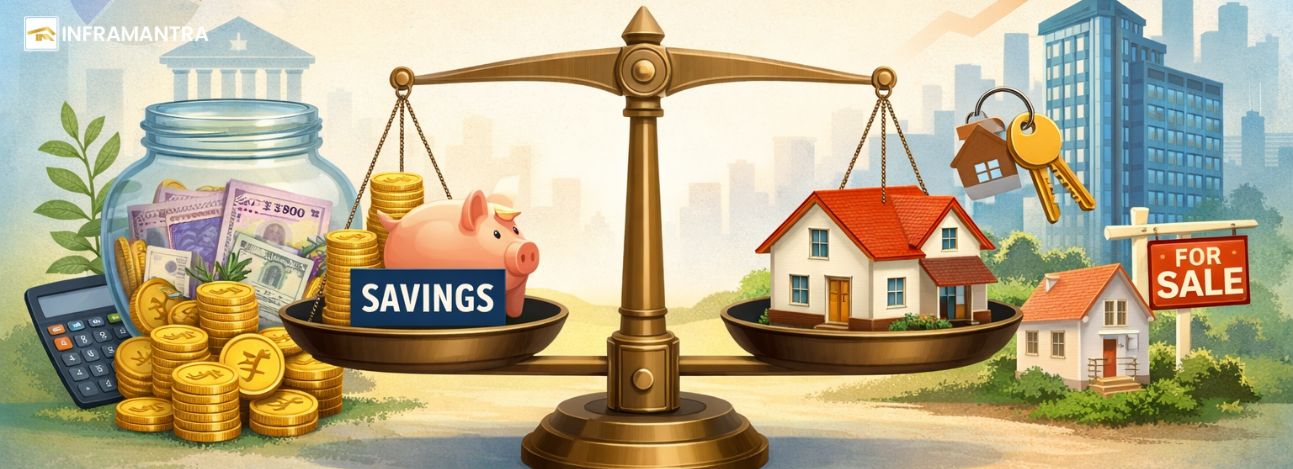
      Savings vs Real Estate Investment: Which Is the Better Option ?

      When it comes to building financial security and long-term wealth, most people find themselves choosing between two popular options: saving money or investing in real estate. While both play an important role in personal finance, they serve very different purposes. Understanding the difference between savings and real estate investment can help you make smarter financial decisions, especially in a fast-growing market like Gurgaon.

      With the rising demand for apartments in Gurgaon and increasing interest in the best residential properties in Gurgaon, real estate has emerged as a preferred investment choice for many. But is it always better than saving? Let’s explore both options in detail to help you decide what suits you best.

      Understanding Savings: Safety and Liquidity

      Savings typically refer to money kept in bank accounts, fixed deposits, or other low-risk financial instruments. The primary goal of saving is capital preservation, not wealth creation.

      Benefits of Savings

      • High liquidity: Savings can be accessed instantly during emergencies.
      • Low risk: Bank savings accounts and fixed deposits are considered safe.
      • Financial discipline: Encourages regular money management.
      • Short-term goals: Ideal for emergency funds, travel, or planned expenses.

      Limitations of Savings

      While savings provide security, they often fail to beat inflation. Over time, the purchasing power of your money may decline, making savings less effective for long-term financial growth. Interest rates on savings accounts are generally low, and returns remain limited.

      Real Estate Investment: Building Long-Term Wealth

      Real estate investment involves purchasing property with the expectation of generating income or benefiting from capital appreciation. In cities like Gurgaon, real estate has become a strong wealth-building tool due to rapid infrastructure development, corporate expansion, and lifestyle upgrades.

      Why Does Real Estate Stand Out?

      • Appreciation potential: Property values tend to increase over time.
      • Passive income: Rental income offers a steady cash flow.
      • Inflation hedge: Property prices and rents usually rise with inflation.
      • Tangible asset: Unlike stocks or savings, real estate is a physical asset.
      • Tax benefits: Home loans and property investments often come with tax advantages.

      The growing demand for apartments in Gurgaon, especially near business hubs, metro corridors, and IT parks, makes real estate a lucrative option for both investors and end-users.

      Gurgaon Real Estate Market: A Hotspot for Investment

      Gurgaon has transformed into one of India’s most dynamic real estate destinations. With excellent connectivity, world-class infrastructure, and proximity to Delhi, the city attracts professionals, entrepreneurs, and global investors alike.

      Some factors driving the popularity of the best residential properties in Gurgaon include:

      • Presence of multinational companies
      • Upcoming expressways and metro expansions
      • High-quality residential projects with modern amenities
      • Strong rental demand from working professionals

      Whether you’re looking for luxury apartments, mid-segment homes, or investment-friendly properties, Gurgaon offers diverse options that align with different budgets and financial goals.

      Which Option Is Better for You?

      The choice between savings and real estate investment depends on your financial goals, risk appetite, and time horizon.

      Choose Savings If:

      • You need immediate access to funds
      • You are building an emergency corpus
      • You have short-term financial goals
      • You prefer zero risk

      Choose Real Estate Investment If:

      • You aim for long-term wealth creation
      • You want passive rental income
      • You can invest for 5-10 years or more
      • You’re interested in high-growth locations like Gurgaon, Noida, Pune, and Jaipur

      Many financial experts recommend a balanced approach, maintaining sufficient savings for emergencies while allocating surplus funds toward real estate investment.

      Why Are Apartments in Gurgaon a Smart Choice?

      Investing in apartments in Gurgaon offers several advantages:

      • Strong appreciation due to urban expansion
      • High rental yield in prime locations
      • Availability of gated communities with lifestyle amenities
      • Increasing demand for residential real estate

      Projects offering smart homes, green living, and integrated townships are especially attractive for both investors and homebuyers.

      Final Thoughts

      Savings and real estate investment are not rivals; they complement each other. Savings provide financial security and peace of mind, while real estate helps grow wealth and generate income. If you’re planning for the future and looking to diversify your portfolio, investing in the best residential properties in Gurgaon can be a rewarding decision.

      By understanding your financial priorities and market opportunities, you can strike the right balance between saving and investing, ensuring both stability today and prosperity tomorrow.

      If you wish to invest in the best residential properties in Gurgaon, all you have to do is connect with an Inframantra property advisor. Inframantra- one of the best real estate consultancy firms in Gurgaon has a wide range of premium to ultra-luxurious properties in the prime areas of the city. Just call or drop your details, an Inframantra property advisor will get in touch with you and from there you can start your home-buying journey with guided site visits and hassle-free home transition process. Call now because time and best properties wait for none.

      You may also like to read:-

      Benefits of Buying Property in a Woman’s Name in India

      Why Home-Buyers Prefer Buying Apartments in Gurgaon over Independent Homes?