Category: News

  • Haryana Land Registration Goes Fully Digital From November 1, 2025

    Haryana Land Registration Goes Fully Digital From November 1, 2025

    Haryana is set to transition to a completely paperless land registration system beginning November 1, 2025, with physical documents and manual verifications being phased out across all tehsils. Under the new system, property deeds will only require digital signatures, a move aimed at eliminating issues like tampering, forgery, and the loss of files.

    The announcement was made by Sumita Misra, Haryana’s Financial Commissioner (Revenue), during a meeting with deputy commissioners to assess the progress of the state’s digital reforms in land and revenue administration. Misra described the shift as a “new chapter” in transparent and citizen-friendly governance, marking Haryana’s complete digital transformation in land records management.

    To ease the transition for the public, the government has allowed stamps purchased before November 3 to remain valid until November 15, 2025, under the new system. In addition, witnesses can now be digitally modified if necessary, Misra explained.

    Tehsildars, naib tehsildars, and registration staff have been directed to complete the registration of user accounts on the revenue department’s online portal without delay. Misra also revealed that the government has set a deadline to resolve all pending property mutation cases by the end of this week. The state is reviewing the current 10-day mutation verification rule and will soon introduce an auto-mutation system starting November 25, aimed at automatically recording ownership transfers to prevent delays and disputes.

    A key component of this reform is the complete ban on manual collection of registration fees. All payments will now be processed exclusively through the official e-governance payment gateway, ensuring greater transparency and accountability. Deed writers have been instructed to stop manually drafting documents, as only digitally generated deeds from the official portal will hold legal validity. These digital deeds will be automatically verified against land records and signed by the relevant authorities, ensuring accuracy and security.

    Misra further directed officials to update and verify all 7A land record numbers and court stay orders in the central system by the upcoming Friday to maintain data integrity. Furthermore, the government will only accept land demarcation requests via the online portal, effectively ending offline submissions. The demarcation process will utilize GPS-enabled rover technology for accurate measurements, with approvals granted by circle revenue officers and kanungos.

    The fee structure for land demarcation has been designed to remain affordable, with charges set at ₹1,000 plus ₹500 per additional acre in rural areas and a flat fee of ₹2,000 in urban areas.

  • Gurugram Leads Luxury Housing Launches with 87% Share in Q3 2025

    Gurugram Leads Luxury Housing Launches with 87% Share in Q3 2025

    Delhi-NCR real estate market witnessed introduction of 10,245 new housing units in Q3 2025, marking a 12% increase from the previous quarter, though still 37% lower compared to the same time last year. Gurugram dominated the luxury housing segment, accounting for 87% of new luxury launches in the region during this period, according to a recent report by Cushman & Wakefield.

    The weighted average price for newly launched properties during this quarter was approximately ₹15,175 per square foot, reflecting a 30% rise from the previous quarter. However, it was 3% lower compared to the same quarter last year. High-end residential areas in NCR saw annual capital appreciation of 5-6%, with Gurugram and Noida leading the growth, with price increases of 12% and 10%, respectively.

    Rental values also saw modest growth. They increased by 1-2% on a quarter-on-quarter basis and 4-6% year-on-year, with Gurugram’s luxury segment experiencing the highest growth at 10%.

    Key active submarkets in NCR included New Gurgaon and the Dwarka Expressway, accounting for 23% and 20% of all new launches, respectively. Greater Noida contributed 14%. The market for mid-end properties led the supply with a 51% share of the new launches, followed by high-end (26%) and luxury (22%) projects.

    Gurugram’s luxury housing market continues to thrive, with high demand driven by improved connectivity to the IGI Airport, evolving infrastructure, and affordability compared to central Gurgaon. Meanwhile, the Noida region has seen strong momentum, particularly with the expected growth of the Noida International Airport.

    You may also like to read:-

    Q3 2025 Real Estate Investment in India Up 48% YoY: CBRE Report

    India’s Real Estate Market Gains Momentum, Ranks 4th in Asia-Pacific Region

    Big Upgrade: 9 Foot Over Bridges and 4 Flyovers on Gurugram-Jaipur Route

  • Landowners Benefit as Haryana Government Allows Bridges Over Revenue Roads for Better Connectivity

    Landowners Benefit as Haryana Government Allows Bridges Over Revenue Roads for Better Connectivity

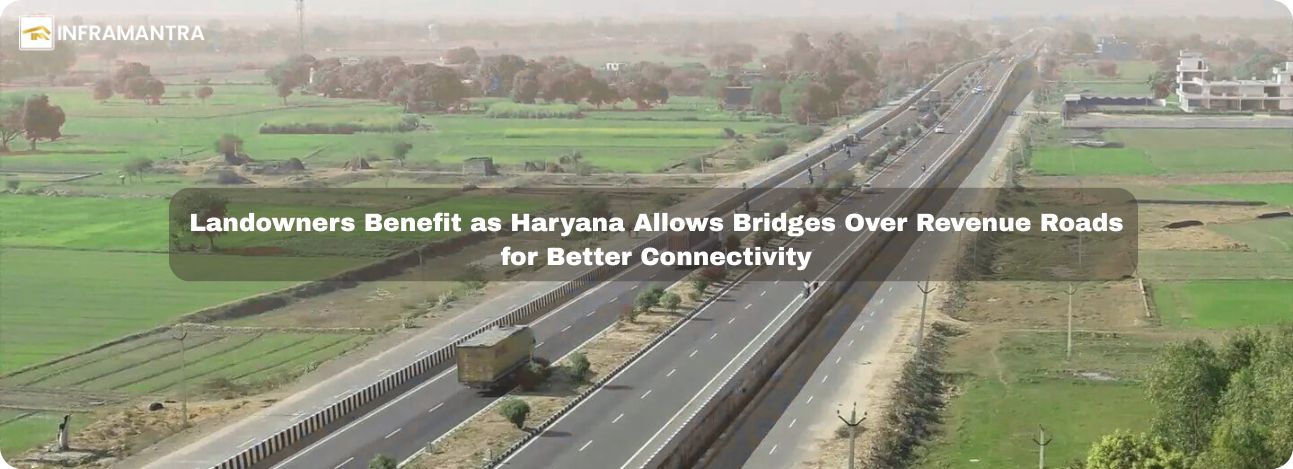
    In a move to support landowners and developers, the Haryana government has unveiled a new policy that grants easement rights over revenue roads, allowing land parcels on either side of these roads to be linked. Revenue roads, or rastas, are designated pathways in government records that usually connect agricultural fields or villages.

    The policy, approved by Haryana Chief Minister Nayab Singh Saini during a cabinet meeting in Chandigarh, allows private landowners to lease land beneath or above these revenue roads. The lease charge will be set at 5% of the agricultural collector rate per square metre annually.

    According to a Haryana government spokesperson, the policy aims to facilitate the optimal use of land by enabling seamless access between divided plots. This connection can be achieved through tunnels, ducts, or overpasses, allowing for the uninterrupted laying of essential services like water, sewage, electricity, and gas pipelines. The key condition is that any such construction must be approved by the local municipality.

    The policy is applicable only to active revenue roads that are up to 6 karam (approximately 10 metres) wide. It does not apply to defunct roads or those that end within a plot, which are excluded from sale under the state’s land valuation policy introduced in November 2021.

    Developers in Gurugram have welcomed this new move, noting that it will significantly benefit various real estate projects. Manjeet Duhan, director of GGanbu Land Pvt Ltd, who recently acquired a revenue rasta in Sector 61 for one of their projects, emphasized the importance of this policy. He explained that although the process to acquire land under a revenue road was available previously, it was complicated and time-consuming. With the new policy in place, developers can now build necessary infrastructure such as tunnels and public amenities more efficiently.

  • Q3 2025 Real Estate Investment in India Up 48% YoY: CBRE Report

    Q3 2025 Real Estate Investment in India Up 48% YoY: CBRE Report

    India’s real estate market continues to demonstrate robust growth, drawing significant investor interest through 2025. According to CBRE South Asia Pvt Ltd’s latest Market Monitor Q3 2025- Investments report, total equity inflows reached ₹90,484 crore (US$10.2 billion) between January and September 2025, a 14% increase compared to the same period last year.

    In the third quarter alone, equity investments surged 48% year-on-year, totaling ₹33,710 crore (US$3.8 billion). This growth was largely driven by rising demand for land parcels, development-ready sites, and completed office and retail properties.

    Notably, over 90% of Q3’s inflows were directed towards land, greenfield projects, and income-generating commercial assets, underscoring continued investor appetite across both development and operational segments. Greenfield developments, particularly in residential, office, mixed-use, data center, and industrial/logistics categories, are expected to remain active into the final quarter of the year and beyond.

    Top Investment Destinations

    Mumbai led all Indian cities, attracting 32% of total equity inflows, followed by Pune with 18% and Bengaluru with 16%. The data highlights a clear preference for India’s established and emerging urban centers as investment destinations.

    Investor Profile and Trends

    Developer contributions formed the largest share of inflows at 45%, with institutional investors comprising 33%. This balance reflects a healthy blend of domestic and global capital backing the sector. With a limited supply of core office assets, CBRE anticipates a shift toward opportunistic investments. However, demand for completed office spaces and retail assets is expected to remain dominant through the end of 2025.

    Looking ahead, the sector’s broadening asset mix and India’s consistent ability to attract cross-border capital are likely to remain key drivers, supporting continued expansion into 2026 and beyond.

  • India’s Real Estate Market Gains Momentum, Ranks 4th in Asia-Pacific Region

    India’s Real Estate Market Gains Momentum, Ranks 4th in Asia-Pacific Region

    India has secured its position as the fourth-largest destination for real estate and development capital in the Asia-Pacific (APAC) region in the first half of 2025. This development highlights India’s growing significance in the global real estate landscape.

    According to the latest Investment Insights H1 2025 report from Colliers, real estate investments across nine major APAC markets totaled US$ 71.9 billion, despite a 6% year-over-year decline. India stood out by attracting significant foreign and domestic investments. Foreign inflows amounted to US$ 1.6 billion, representing around 52% of institutional capital, while domestic investments saw a notable 53% year-over-year increase, making up nearly half of the total capital influx.

    Residential and office spaces have been particularly popular, with strong demand driven by stabilizing interest rates and expectations of increased consumption during the festive season. Key private equity land deals included Brookfield Group’s US$ 70.1 million investment in Mumbai, EcoBox Industrial Parks’ US$ 48.3 million commitment in Chennai, and Golden Growth Fund’s US$ 21.1 million acquisition in Delhi-NCR.

    Development-focused investments also remained strong. The Welspun One WOLP Fund 2 committed US$ 229.4 million towards multi-city industrial and warehousing projects. Other notable deals include US$ 116 million by CapitaLand India Trust for an office project in Bengaluru and a joint venture between Mitsubishi Estate Co. and Birla Estates for residential assets in Bengaluru, valued at US$ 65 million. HDFC Capital Advisors and Eldeco Group together invested US$ 175 million in residential developments.

    Looking ahead, Colliers anticipates that India will continue to attract significant real estate investment in the second half of 2025. This momentum is expected to be driven by rising demand in office spaces, residential properties, and emerging sectors such as data centres, senior living, and life sciences. With inflation easing and yield spreads improving, experts predict further acceleration in capital inflows, solidifying India’s position as a key player in the global real estate market.

    You may also like to read:

    RERA Launches Unified Digital Platform to Track Projects, Protect Buyers

    India’s InvIT Market to Triple by 2030, Reaching Rs. 22.45 Lakh Crore

    Big Upgrade: 9 Foot Over Bridges and 4 Flyovers on Gurugram-Jaipur Route

  • RERA Launches Unified Digital Platform to Track Projects, Protect Buyers

    RERA Launches Unified Digital Platform to Track Projects, Protect Buyers

    In a significant move to enhance transparency and coordination in the real estate sector, the Ministry of Housing and Urban Affairs launched the Unified RERA Portal during the 5th meeting of the Central Advisory Council (CAC) under the Real Estate (Regulation and Development) Act (RERA), 2016. The event took place at Sankalp Bhawan, New Delhi.

    The meeting began with a welcome address by Joint Secretary (Housing), Kuldip Narayan, followed by insights from Secretary Srinivas Katikithala, who reflected on the eight-year journey of RERA’s implementation.

    Union Minister of Housing and Urban Affairs, Manohar Lal Khattar, formally launched the portal, rera.mohua.gov.in in the presence of Minister of State Tokhan Sahu, state RERA heads, government officials, industry bodies, and homebuyer representatives. The portal aims to bring all stakeholders under a unified digital platform, promote transparency, and enable knowledge sharing across states and Union Territories.

    Calling the launch a “major step” forward, Minister Khattar said the portal would strengthen accountability and empower homebuyers by offering a centralized database of projects. He also urged states and UTs to implement RERA “in letter and spirit” to ensure timely project delivery and citizen protection.

    The Council reviewed key progress made under RERA: 35 states/UTs have operational regulatory authorities, 29 appellate tribunals are functional, over 1.5 lakh projects and 1 lakh real estate agents are registered, and nearly 1.47 lakh consumer complaints have been resolved.

    A major focus of the meeting was addressing stalled projects. The Council discussed the Amitabh Kant-led committee’s recommendations, already being implemented in Uttar Pradesh, and called for their adoption nationwide. Members emphasized the need for standardized enforcement procedures and a nationwide project database powered by AI tools to monitor risks and improve oversight.

    Minister of State, Mr. Tokhan Sahu highlighted the urgent need to revive legacy stalled projects and accelerate grievance redressal mechanisms. The meeting concluded with a strong push for coordinated action across states to uphold RERA’s core objective, protecting homebuyer interests and ensuring project completion.

    You may also like to read:

    Urban Extension Road II (UER 2): Route Map, Key Features and Future Expansion

    India’s InvIT Market to Triple by 2030, Reaching Rs. 22.45 Lakh Crore

  • Big Upgrade: 9 Foot Over Bridges and 4 Flyovers on Gurugram-Jaipur Route

    Big Upgrade: 9 Foot Over Bridges and 4 Flyovers on Gurugram-Jaipur Route

    To improve road safety and reduce traffic congestion, the National Highways Authority of India (NHAI) has announced a major infrastructure upgrade along the Gurugram-Jaipur stretch of the Delhi-Jaipur Expressway. Under this project, nine new foot over bridges (FOBs) and four flyovers will be constructed at key points on the highway.

    The Gurugram-Jaipur section is known for heavy traffic and frequent accidents, especially involving pedestrians. In response, the NHAI has taken the initiative to build FOBs at locations where pedestrians often cross the road, risking their lives.

    Locations for the New Foot Over Bridges

    A total of 9 foot over bridges will be installed. Each of these FOBs will have both stairs and ramps, making them accessible for all, including the elderly and differently-abled. These will be constructed at:

    1. Shikohpur
    2. Manesar (near NSG Camp)
    3. Binola
    4. Rathivas
    5. Malpura
    6. Jaisinghpurkheda
    7. Sidharawali
    8. Kharkhara
    9. Khajuri

    Each foot over bridge is expected to cost around Rs.15 crores. 

    Four New Flyovers for Smoother Traffic

    In addition to the FOBs, four flyovers will be built to ease vehicular movement and reduce bottlenecks on the highway. These will come up at:

    • Pachgaon Chowk
    • Rathivas
    • Near Hero Company in Dharuheda
    • Sahlawas

    This entire infrastructure plan is part of a Rs.282 crore development project that also includes expansion of service roads and improvement of drainage systems along the expressway. 

    Officials hope this move will significantly lower the number of accidents, particularly those involving pedestrians crossing busy roads. The flyovers will help reduce traffic jams, especially in high-density areas like Manesar and Dharuheda. Once completed, this development is expected to make commuting safer and more efficient for thousands of daily travelers between Gurugram and Jaipur.

  • India’s InvIT Market to Triple by 2030, Reaching Rs. 22.45 Lakh Crore

    India’s InvIT Market to Triple by 2030, Reaching Rs. 22.45 Lakh Crore

    India’s Infrastructure Investment Trusts (InvITs) are rapidly emerging as one of the country’s most promising asset classes, with their market size projected to reach Rs. 22.45 lakh crore by 2030. This marks a 3.5-fold jump from Rs. 6.38 lakh crore estimated for FY25, according to Knight Frank India.

    Currently, InvITs are growing faster than their real estate counterparts, REITs, which hold Rs. 1.79 lakh crore in assets. Together, InvITs and REITs are expected to manage Rs. 8.17 lakh crore in assets by FY25, up from Rs. 3.66 lakh crore in FY20.

    India now ranks as the fourth-largest REIT and InvIT market in Asia, with five REITs and 17 InvITs listed on exchanges, collectively valued at Rs. 2.89 lakh crore .

    This surge is driven by robust government policies, including the National Monetisation Pipeline (NMP), and rising investor interest in infrastructure sectors. The government’s infrastructure spending has increased from Rs. 1.04 lakh crore in FY15 to Rs. 6.52 lakh crore in FY25, now 2% of India’s GDP.

    InvITs are expected to play a key role in financing India’s Rs. 191.5 lakh crore infrastructure needs by 2030. However, the current penetration remains limited: InvITs manage just 21% of NHAI toll assets, 2% of solar capacity, and one-third of telecom towers. Sectors like logistics, airports, and urban infrastructure remain largely untapped.

    The upcoming NMP 2.0 aims to unlock Rs. 10 lakh crore through asset monetisation by 2030. Investor confidence is being bolstered by risk-sharing models, viability gap funding, and improved governance.

    Experts say, expanding into new sectors such as data centres and water infrastructure, along with broader retail participation and higher institutional investment from pension and insurance funds, will be crucial to scaling up. India’s InvIT market is not just transforming infrastructure financing, it’s also attracting global investor attention as a powerful long-term opportunity.

    Source: IBEF

    You may also like to read:-

    Big Boost for NCR: PM Modi to Inaugurate UER-2, Dwarka Expressway on August 16, 2025

    MCG Elects Finance Panel, Pushes for Smarter Infrastructure

    Tulip Violet

  • Big Boost for NCR: PM Modi to Inaugurate UER-2, Dwarka Expressway on August 16, 2025 

    Big Boost for NCR: PM Modi to Inaugurate UER-2, Dwarka Expressway on August 16, 2025 

    Delhi-NCR commuters can look forward to a major relief from traffic woes as Prime Minister Narendra Modi is set to inaugurate two key infrastructure projects-Urban Extension Road-II (UER-2) and the Delhi stretch of the Dwarka Expressway on August 16. These long-awaited expressways are expected to drastically cut travel time between Noida and Indira Gandhi International (IGI) Airport, reducing the journey to just 20 minutes from the current two hours.

    The 76-kilometre-long UER-2 and 29-kilometre-long Dwarka Expressway are part of the central government’s plan to decongest Delhi’s overloaded arterial roads and Ring Road. The new access-controlled corridors will allow seamless travel across the National Capital Region (NCR), especially benefiting travelers coming from Chandigarh, Gurugram, Jaipur, and other northern cities.

    According to officials, all major works on both stretches are now complete, with final touches underway ahead of the grand launch. The inauguration ceremony will be held on the Dwarka Expressway and will be attended by several dignitaries, including Union Minister for Road Transport and Highways Nitin Gadkari, Delhi Chief Minister Rekha Gupta, Haryana Chief Minister Nayab Singh Saini, and local MPs and MLAs. 

    What is UER-2?

    The Urban Extension Road-II has been designed to function as a new Outer Ring Road for Delhi. It promises to improve airport connectivity and link major parts of Delhi with key NCR cities like Sonipat, Panipat, Karnal, Rohtak, and Bahadurgarh.

    Built at a cost of approximately ₹8,000 crore, the expressway stretches from Alipur (on the Delhi-Chandigarh highway), passes through Mundka, Bakkarwala, Najafgarh, and Dwarka, and finally connects with the Delhi-Jaipur highway at Mahipalpur near IGI Airport.

    Key Connectivity Highlights:

    • Connects with Delhi-Chandigarh Highway at Alipur
    • Joins Delhi-Rohtak Highway at Mundka
    • Links with Sonipat Highway at Bawana

    The UER-2 project is being developed in four major phases, with multiple spur roads enhancing regional connectivity. These phases will link key urban and suburban areas, including Tughlakabad, Okhla, Tronica City, and Burari, and extend connections to major expressways like the Delhi-Mumbai Expressway, Delhi-Amritsar-Katra Expressway, and Badarpur-Noida Expressway.

    Once operational, the network is expected to save travel time, reduce fuel consumption, and significantly ease traffic congestion in and around the capital. For lakhs of daily commuters and frequent fliers, this could mark a permanent solution to one of Delhi-NCR’s biggest transportation challenges.

    You may also like to read:-

    Urban Extension Road II (UER 2): Route Map, Key Features and Future Expansion

  • MCG Elects Finance Panel, Pushes for Smarter Infrastructure

    MCG Elects Finance Panel, Pushes for Smarter Infrastructure

    The Municipal Corporation of Gurugram (MCG) held its general house meeting on Monday, where several major infrastructure and civic development proposals were approved. The session, held at the Haryana Institute of Public Administration in Sector 18, also included the induction of new members and the election of representatives to the finance and contract committee.

    A major highlight of the meeting was the presentation of the 2023-24 audit report, followed by the unanimous approval of multiple development-focused proposals. These include the expansion of rainwater harvesting systems, the installation of name boards for councillors, a rate contract for streetlight installations, and the transfer of land to the health department for setting up a new urban primary health centre. The House also passed plans to organise special camps for water connection meters and to establish compressed biogas plants in each of the four municipal zones.

    Three newly nominated members, Sachin Devtwal, Vikrant Yadav, and Krishan Swami, were sworn in at the start of the session. Additionally, two councillors were elected to the finance and contract committee, which will oversee financial and contractual decisions of the MCG.

    Mayor Raj Rani Malhotra highlighted the corporation’s ongoing commitment to the city’s development. She stressed the importance of public participation in civic initiatives and reiterated MCG’s focus on rainwater harvesting, sewage management, clean drinking water, and environmental conservation. “The benefits of these efforts will multiply when citizens actively take part,” she added. 

    Commissioner Pradeep Dahiya informed the House about the creation of a Sewerage Monitoring Cell, which has identified 40 critical drainage points across the city. Plans are underway to address these issues by April 2026 using modern monitoring technologies to improve responsiveness to citizen complaints.

    The meeting saw the active involvement of elected councillors and senior officials from departments including engineering, accounts, and town planning. The discussions reflected a collective resolve to transform Gurugram into a cleaner, more sustainable, and citizen-friendly city.