Author: Alka

  • Top 3 BHK Flats in Gurgaon: Location and Amenities

    Top 3 BHK Flats in Gurgaon: Location and Amenities

    Known for its thriving corporate landscape, modern infrastructure, and lifestyle-centric urban planning, Gurgaon continues to draw homebuyers in large numbers. Among the many housing options available, 3BHK flats in Gurgaon have seen a significant surge in demand, a trend that’s not just confined to luxury buyers but also middle-income families, young professionals, and long-term investors.

    Whether it’s for setting up a home office, accommodating a growing family, or securing a high-yield rental asset, 3BHK flats in Gurgaon are quickly becoming the go-to choice in the residential segment. In this blog, we will explore the best residential projects offering 3BHK flats in Gurgaon. Also, why you should consider buying 3BHK flats in Gurgaon. 

    Best 3BHK Flats in Gurgaon Offered by Top Real Estate Developers

    Gurgaon’s rapid development, rising rental demand, and growing preference for spacious homes make now the perfect time to invest in a 3bhk flats in Gurgaon. If you are looking for a 3BHK flat for sale in Gurgaon, here’s a list of best residential properties in the city by leading real estate developers: 

    1. Whiteland The Aspen 

    Location: Sector 76, NH8, Gurgaon 

    Whiteland The Aspen is a premium residential project by Whiteland Corporation, offering ultra-luxurious high-rise apartments in 3BHK, 4BHK, 5BHK configurations, and duplex penthouses. Designed by renowned architect Hafeez Contractor, the development features G+34 floors with spacious, efficient layouts. Located near NH8 and Southern Peripheral Road (SPR), it provides easy connectivity. Residents enjoy top-tier amenities, including three exclusive clubhouses: Aurora, Sol, and Astrum, a modern gym, swimming pool, yoga studio, cinema, gastro pub, bowling alley, and more. 

    To know more about Whiteland The Aspen, Gurgaon, click HERE

    2. Vatika Seven Elements

    Location: Sector 89A, New Gurgaon 

    Vatika Seven Elements, located in Sector 89A, Gurgaon, is a premium residential project by the renowned Vatika Group. Offering low-density living with only 45 families per acre, it blends luxury with sustainability. The project features spacious, well-ventilated apartments with high ceilings and quality finishes. Residents enjoy top-class amenities including a swimming pool, gym, clubhouse, cycling track, badminton court, billiards room, and party hall. With over 2.5 acres of greenery, a tree-lined driveway, and eco-friendly features like rainwater harvesting and a sewage treatment plant, the SEAC Haryana gold-rated project ensures comfort, safety, and a green lifestyle in a prime location.

    To know more about Vatika Seven Elements, Sector 89A, Gurgaon, please click HERE

    3. Experion The Trillion

    Location: Sector 48, Subhash Chowk, Gurgaon

    Experion The Trillion is a luxury residential project by Experion Developers, certified by GRIHA and IWBI for sustainable and wellness-focused living. Spread over 5.5 acres with 80% open space, the project features three crescent-shaped S+45 high-rise towers, designed by renowned DP Architects. Offering 3BHK and 4BHK residences (2850–3600 sq.ft.), each unit includes two master bedrooms, walk-in closets, and guest room balconies. Residents enjoy world-class amenities across 1 lakh sq.ft., including gyms, yoga zones, and sports courts. Located near Central Park Resorts, the project ensures excellent connectivity and proximity to top schools, business hubs, and metro stations.

    To know more about Experion The Trillion, please click HERE

    4. Shapoorji Pallonji The Dualis

    Location: Sector 46, Sohna Road, Gurgaon 

    Shapoorji Pallonji The Dualis is an ultra-luxury residential project located in Sector 46, Gurgaon, close to the upcoming IKEA. Spread across 2 acres, the development features two high-rise towers with G+40 floors, offering 3BHK and 4BHK apartments, each with a separate servant quarter. The apartments range from 2850 to 3600 sq.ft. and come with wrap-around balconies, Vastu-compliant layouts, and no south-facing units. With only 198 units, the project ensures exclusivity. Amenities include a two-level grand clubhouse, sky deck, kids’ play zone, swimming pool, high-speed elevators, and multi-tier security. The project offers seamless access to Sohna Road, NH8, and Millennium City Center Metro Station.

    To know more about Shapoorji Pallonji The Dualis, Sector 46, Gurgaon, please click HERE

    5. Signature Global Cloverdale

    Location: Sector 71, Southern Peripheral Road, Gurgaon 

    Signature Global Cloverdale is a premium residential project set within a 125-acre integrated township in Gurgaon, spanning 9 acres with six G+35 high-rise towers. Offering 764 luxurious 3BHK, 3.5BHK, and 4.5BHK apartments (2,100-3,500 sq. ft.), the project is designed for modern upscale living. Each tower features a grand triple-height lobby, with select towers offering just two residences per floor for added exclusivity. Strategically located near Cyber City 2, Global City CBD, SPR metro access, and a proposed heliport, it ensures excellent connectivity. Amenities include 60,000 sq. ft. of clubhouses, pools, co-working zones, spa, banquet hall, and more.

    To know more about Signature Global Cloverdale, Sector 71, Gurgaon, please click HERE

    6. Whiteland Westin Residences

    Location: Sector 103, Dwarka Expressway, Gurgaon 

    Whiteland The Westin Residences in Sector 103, Gurgaon, is India’s first Westin-branded residential development, offering an unparalleled blend of luxury, design, and hospitality. Sprawled across 21 acres on Dwarka Expressway, the project features 13 towers with G+42 floors, designed by architect Hafeez Contractor, landscaped by Coopers Hill, and interiors by Bobby Mukherji & Associates. The 3BHK and 4BHK apartments (2537-4112 sq.ft.) come with dual master bedrooms, attached balconies, and stunning views. Residents enjoy five-star amenities including a 1.75 lakh sq.ft. clubhouse, restaurants, pools, concierge, guest suites, and more. The location ensures excellent connectivity to IGI Airport, Diplomatic Enclave, and Cyber Hub.

    To know more about Whiteland Westin Residences, Sector 103, Gurgaon, please click HERE

    7. BPTP GAIA Residences 

    Location: Sector 102, Dwarka Expressway, Gurgaon  

    BPTP GAIA Residences is a newly launched luxury residential project by BPTP, located on Dwarka Expressway within the BPTP Amstoria Verti-Greens township. Spread across 3 acres, it is the first full-glass façade residential development in the area, offering 3 towers with 3 sky gardens each, featuring amenities like open lounges, libraries, and business spaces. The IGBC pre-certified project includes 531 thoughtfully designed 3BHK flats (1621–1689 sq.ft.) with multiple balconies for natural light and ventilation. Residents enjoy access to 1.75 lakh sq.ft. of amenities including 3 clubhouses, pools, fitness zones, banquet halls, guest suites, and more. The location offers excellent connectivity to Delhi, Gurgaon, and IGI Airport.

    To know more about BPTP GAIA Residences, Sector 102, Gurgaon, please click HERE

    5 Reasons why you should consider buying 3BHK flats in Gurgaon? 

    1. Spacious Living

    3BHK flats offer ample room for families, ensuring privacy and comfort for each member. They also accommodate home offices or guest rooms, supporting evolving lifestyle needs.

    2. Strong ROI & Appreciation

    Gurgaon’s booming real estate market ensures long-term value growth. High demand in key sectors boosts rental yields and resale potential.

    3. Better Lifestyle Amenities

    Most 3BHK projects come with premium features like clubhouses, pools, and sports facilities. These enhance daily living and promote a well-balanced lifestyle.

    4. Ideal for Growing Families

    With extra bedrooms and bathrooms, 3BHKs cater to expanding families. They provide flexibility for future needs like a study room or nursery.

    5. Excellent Connectivity

    Gurgaon offers seamless access to Delhi, IGI Airport, and major expressways. Upcoming metro links and infrastructure projects further boost convenience.

    Why Inframantra?

    Inframantra is one of the leading property-advisory companies that works in conjunction with the top real estate developers in Gurgaon. Inframantra offers best-in-class home-buying services to home-buyers and investors from in-depth consultation to timely site visits, seamless documentation to assistance in finding the right loan, key-handovers to after sale assistance. The company has a huge inventory of  freshly launched, under-construction, and ready-to-move-in projects with all the details about the projects in one place. 

    The best part is that, you can directly connect with an Inframantra property advisor and receive all the details about properties in and around your preferred location. You can avail all these services brokerage-free. So, if you are interested in any of these properties or want to explore more high-end properties, connect with Inframantra and book your next home at the best price. 

    Frequently Asked Questions (FAQs)

    1. What is the cost of a 3bhk flat in Gurgaon?

    The cost of the 3bhk flat in Gurgaon mainly depends on factors such as the location, amenities offered within the property, connectivity to major roads and highways, quality of development, and infrastructure development in and around the area. So, keep these factors in mind before deciding a budget for your next property. 

    2. Is buying 3bhk in Gurgaon a good investment?

    Yes! Gurgaon is experiencing rapid growth in Infrastructure and commercial developments. It is one of the fastest-growing business hubs in the country. This is one of the main reasons why properties in Gurgaon have witnessed high appreciation in just a few years. 

    3. Where can I find the best 3bhk flats in Gurgaon?

    To explore all the best options in 3bhk flats in Gurgaon, we would suggest you to visit Inframantra website or connect with an Inframantra property advisor. 

    4. Which locality has the best 3bhk flats in Gurgaon?

    Some of the popular localities to offer 3bhk flats in Gurgaon are the sectors near Dwarka Expressway, and Southern Peripheral Road. 

    You may also like to read:-

    Top 3BHK Flats in Dwarka Expressway

    Top 5 Townships in Gurgaon to Invest

    Top 5 Best Societies in Gurgaon

    Alka Gurung
    Written by

    Alka Gurung

    SEO Content Writer

    Alka Gurung is an SEO Content Writer at INFRAMANTRA, with 15 years of experience in content writing across real estate and other industries. She specialises in covering Gurgaon’s real estate market, luxury residential projects, and practical guides for homebuyers and investors. Her expertise lies in turning market data and on-ground insights into clear, informative, and useful content that helps readers make confident property decisions.

  • India’s InvIT Market to Triple by 2030, Reaching Rs. 22.45 Lakh Crore

    India’s InvIT Market to Triple by 2030, Reaching Rs. 22.45 Lakh Crore

    India’s Infrastructure Investment Trusts (InvITs) are rapidly emerging as one of the country’s most promising asset classes, with their market size projected to reach Rs. 22.45 lakh crore by 2030. This marks a 3.5-fold jump from Rs. 6.38 lakh crore estimated for FY25, according to Knight Frank India.

    Currently, InvITs are growing faster than their real estate counterparts, REITs, which hold Rs. 1.79 lakh crore in assets. Together, InvITs and REITs are expected to manage Rs. 8.17 lakh crore in assets by FY25, up from Rs. 3.66 lakh crore in FY20.

    India now ranks as the fourth-largest REIT and InvIT market in Asia, with five REITs and 17 InvITs listed on exchanges, collectively valued at Rs. 2.89 lakh crore .

    This surge is driven by robust government policies, including the National Monetisation Pipeline (NMP), and rising investor interest in infrastructure sectors. The government’s infrastructure spending has increased from Rs. 1.04 lakh crore in FY15 to Rs. 6.52 lakh crore in FY25, now 2% of India’s GDP.

    InvITs are expected to play a key role in financing India’s Rs. 191.5 lakh crore infrastructure needs by 2030. However, the current penetration remains limited: InvITs manage just 21% of NHAI toll assets, 2% of solar capacity, and one-third of telecom towers. Sectors like logistics, airports, and urban infrastructure remain largely untapped.

    The upcoming NMP 2.0 aims to unlock Rs. 10 lakh crore through asset monetisation by 2030. Investor confidence is being bolstered by risk-sharing models, viability gap funding, and improved governance.

    Experts say, expanding into new sectors such as data centres and water infrastructure, along with broader retail participation and higher institutional investment from pension and insurance funds, will be crucial to scaling up. India’s InvIT market is not just transforming infrastructure financing, it’s also attracting global investor attention as a powerful long-term opportunity.

    Source: IBEF

    You may also like to read:-

    Big Boost for NCR: PM Modi to Inaugurate UER-2, Dwarka Expressway on August 16, 2025

    MCG Elects Finance Panel, Pushes for Smarter Infrastructure

    Tulip Violet

    Alka Gurung
    Written by

    Alka Gurung

    SEO Content Writer

    Alka Gurung is an SEO Content Writer at INFRAMANTRA, with 15 years of experience in content writing across real estate and other industries. She specialises in covering Gurgaon’s real estate market, luxury residential projects, and practical guides for homebuyers and investors. Her expertise lies in turning market data and on-ground insights into clear, informative, and useful content that helps readers make confident property decisions.

  • Top 5 Townships in Gurgaon to Invest – New and Upcoming Projects 2025

    Top 5 Townships in Gurgaon to Invest – New and Upcoming Projects 2025

    Gurgaon’s real estate market is witnessing high demand for luxury and premium residential and commercial properties. Boosting the demand, top developers in Gurgaon have started focusing towards developing mixed-use townships in Gurgaon, offering both dedicated residential spaces and retail and commercial zones in one place. 

    If you are looking for a home or planning to own a property in such townships, here are the best 5 townships in Gurgaon for you. 

    Best 5 Townships in Gurgaon – Key Details and Highlights

    1. DLF PRIVANA 

    DLF Privana is a premium, master-planned community spread across 116 acres in Sectors 76 & 77, Gurugram. Surrounded by greenery and close to the Aravalis, it offers wide open spaces, shaded boulevards, and a serene lifestyle. After the successful sell-outs of Privana South and West, DLF Privana North is now under development, featuring iconic 50-storey towers with 1164 spacious 4BHK + Study apartments and penthouses on 17.7 acres. With 80% open spaces and seamless connectivity via NH-8, SPR, and Golf Course Road, it offers luxury living starting at ₹9 Cr-perfect for those seeking elegance, comfort, and convenience in one address. 

    To know more about DLF Privana North, click HERE. 

    2. SIGNATURE GLOBAL DAXIN VISTAS

    Signature Global Daxin Vistas is set to be Gurgaon’s largest integrated township, spread across 130 acres with 3000 low-rise homes. Phase 1 launches with 600 spacious S+4 residences, each floor featuring a single apartment with balconies in every room for great ventilation. Homes range from 1530-1550 sq. ft., plus exclusive spaces, basement access for lower floors and private terraces for top-floor units. Enjoy premium amenities like multiple clubhouses, schools, spa, gym, swimming pool, and green zones. Located near Sohna Toll Plaza, with easy access to Golf Course Extension Road, SPR, and Cyber City 2, this is modern living, redefined.

    To  know more about Signature Global Daxin Vistas,  click HERE

    3. ASHIANA AMARAH

    Ashiana Amarah is a unique kid-centric residential community spread across 22.1 acres in 5 phases, with 1200 homes and 248 units launched in Phase V. Designed for young families, it offers 78% open spaces, low density (55 units/acre), and 6.7 acres of landscaped greens. The project includes a 32,000 sq. ft. clubhouse and a 6,000 sq. ft. Learning Hub with 5 dedicated spaces: Art & Craft Room, Dance Room, Music Room, Reading Hub, and Workshop Room. With play streets, sports zones, swimming pool, and doorstep play areas, Amarah nurtures learning, creativity, and active lifestyles for children.

    To  know more about Ashiana Amarah, connect with an Inframantra Property Expert.  

    4. ELAN THE EMPEROR 

    Elan The Emperor is a part of 50+ acres of integrated township located at Sector 106, Gurgaon. The project comprises high-rise residential complexes, office-spaces, high-end retail, hotel, and commercial zones. One of the highlights of this project is its Billionaire Club, a symbol of ultra-luxury and architectural excellence. Every detail has been crafted for an unmated lifestyle feature more than 100 amenities such as a heated swimming pool, nature trails and wellness gardens, creche, multiplayer playstation room, fully-loaded gym and indoor sports zones, studios for yoga, zumba, aerobics, and pilates, and so much more. It also has luxurious dining spaces which includes a multicuisine restaurant, cigar lounge, bar, event spaces, and the list goes on. 

    To  know more about Elan The Emperor, connect with an Inframantra Property Expert.  

    5. GLOBAL CITY, GURGAON

    The Global City is a visionary mixed-use township being developed by HSIIDC, a fully state-owned agency of the Haryana Government. Spread across 1,000+ acres in Gurugram’s Sectors 36, 36B, 37, and 37B, it offers seamless connectivity via the Dwarka Expressway, Pataudi Road, and NH-48. This integrated development will feature premium offices, residences, retail, green spaces, water bodies, and robust infrastructure. With modern planning, smart city features, and inclusive social amenities, Global City is designed to be a self-sustaining urban hub, setting a new benchmark for township development in India and contributing significantly to Haryana’s economic growth.

    It is without a doubt that Gurgaon is witnessing a fast infrastructural development across the city.  If you want to own a home in a prime location of Gurgaon, then all you need to do is visit Inframantra’s official website. Here, you will find all the premium properties developed by top real estate companies in Gurgaon along with top-notch, brokerage-free, home-buying services. Also, if you want to enjoy faster-property appreciation while owning a home of your own, Inframantra has the best options for you.  

    You may also like to read:

    Luxury Apartments in Gurgaon

    Top 5 Best Societies in Gurgaon

    REITs vs Real Estate Mutual Funds vs Fractional Ownership

    Alka Gurung
    Written by

    Alka Gurung

    SEO Content Writer

    Alka Gurung is an SEO Content Writer at INFRAMANTRA, with 15 years of experience in content writing across real estate and other industries. She specialises in covering Gurgaon’s real estate market, luxury residential projects, and practical guides for homebuyers and investors. Her expertise lies in turning market data and on-ground insights into clear, informative, and useful content that helps readers make confident property decisions.

  • Big Boost for NCR: PM Modi to Inaugurate UER-2, Dwarka Expressway on August 16, 2025 

    Big Boost for NCR: PM Modi to Inaugurate UER-2, Dwarka Expressway on August 16, 2025 

    Delhi-NCR commuters can look forward to a major relief from traffic woes as Prime Minister Narendra Modi is set to inaugurate two key infrastructure projects-Urban Extension Road-II (UER-2) and the Delhi stretch of the Dwarka Expressway on August 16. These long-awaited expressways are expected to drastically cut travel time between Noida and Indira Gandhi International (IGI) Airport, reducing the journey to just 20 minutes from the current two hours.

    The 76-kilometre-long UER-2 and 29-kilometre-long Dwarka Expressway are part of the central government’s plan to decongest Delhi’s overloaded arterial roads and Ring Road. The new access-controlled corridors will allow seamless travel across the National Capital Region (NCR), especially benefiting travelers coming from Chandigarh, Gurugram, Jaipur, and other northern cities.

    According to officials, all major works on both stretches are now complete, with final touches underway ahead of the grand launch. The inauguration ceremony will be held on the Dwarka Expressway and will be attended by several dignitaries, including Union Minister for Road Transport and Highways Nitin Gadkari, Delhi Chief Minister Rekha Gupta, Haryana Chief Minister Nayab Singh Saini, and local MPs and MLAs. 

    What is UER-2?

    The Urban Extension Road-II has been designed to function as a new Outer Ring Road for Delhi. It promises to improve airport connectivity and link major parts of Delhi with key NCR cities like Sonipat, Panipat, Karnal, Rohtak, and Bahadurgarh.

    Built at a cost of approximately ₹8,000 crore, the expressway stretches from Alipur (on the Delhi-Chandigarh highway), passes through Mundka, Bakkarwala, Najafgarh, and Dwarka, and finally connects with the Delhi-Jaipur highway at Mahipalpur near IGI Airport.

    Key Connectivity Highlights:

    • Connects with Delhi-Chandigarh Highway at Alipur
    • Joins Delhi-Rohtak Highway at Mundka
    • Links with Sonipat Highway at Bawana

    The UER-2 project is being developed in four major phases, with multiple spur roads enhancing regional connectivity. These phases will link key urban and suburban areas, including Tughlakabad, Okhla, Tronica City, and Burari, and extend connections to major expressways like the Delhi-Mumbai Expressway, Delhi-Amritsar-Katra Expressway, and Badarpur-Noida Expressway.

    Once operational, the network is expected to save travel time, reduce fuel consumption, and significantly ease traffic congestion in and around the capital. For lakhs of daily commuters and frequent fliers, this could mark a permanent solution to one of Delhi-NCR’s biggest transportation challenges.

    You may also like to read:-

    Urban Extension Road II (UER 2): Route Map, Key Features and Future Expansion

    Alka Gurung
    Written by

    Alka Gurung

    SEO Content Writer

    Alka Gurung is an SEO Content Writer at INFRAMANTRA, with 15 years of experience in content writing across real estate and other industries. She specialises in covering Gurgaon’s real estate market, luxury residential projects, and practical guides for homebuyers and investors. Her expertise lies in turning market data and on-ground insights into clear, informative, and useful content that helps readers make confident property decisions.

  • 14-km Road Upgrade to Ease Traffic in Old Gurugram, Says GMDA

    14-km Road Upgrade to Ease Traffic in Old Gurugram, Says GMDA

    The Gurugram Metropolitan Development Authority (GMDA) has announced a major infrastructure upgrade that is expected to transform traffic flow in Old Gurugram. According to a report by Hindustan Times, a 14-km-long road link connecting IFFCO Chowk to the Dwarka Expressway via Basai Road is set to be revamped to reduce congestion in one of the city’s busiest areas.

    This crucial stretch currently runs from IFFCO Chowk in Sukhrali Village, through Mahavir Chowk, Sadar Bazar, Gurudwara Road, Bhuteshwar Mandir intersection, and onto Basai Road, eventually connecting to the Dwarka Expressway via the Basai flyover.

    Several construction works are planned under the project, including road resurfacing, removal of illegal encroachments, and widening of key segments. As per the HT report, the GMDA has already conducted a detailed traffic analysis and survey of the area.

    A GMDA official told, “This stretch is in the heart of Old Gurugram, and we have decided to relay the road and build a surface drainage system along the entire length to prevent waterlogging.”

    Although earlier plans included the addition of flyovers and further expansion, those were dropped due to space limitations. The current focus is on improving the existing road alignment.

    The project will start from Basai and eventually extend toward Bhuteshwar Mandir. The route will connect Jail Land, Mahavir Chowk, and MG Road before concluding at IFFCO Chowk. A comprehensive cost estimate is expected within a month, after which construction will begin. Once completed, the GMDA anticipates smoother traffic flow and better connectivity between Old Gurugram and Dwarka Expressway, eliminating major traffic bottlenecks in the process.

    Alka Gurung
    Written by

    Alka Gurung

    SEO Content Writer

    Alka Gurung is an SEO Content Writer at INFRAMANTRA, with 15 years of experience in content writing across real estate and other industries. She specialises in covering Gurgaon’s real estate market, luxury residential projects, and practical guides for homebuyers and investors. Her expertise lies in turning market data and on-ground insights into clear, informative, and useful content that helps readers make confident property decisions.

  • REITs vs Real Estate Mutual Funds vs Fractional Ownership : A Clear Guide for Indian Investors

    REITs vs Real Estate Mutual Funds vs Fractional Ownership : A Clear Guide for Indian Investors

    There’s a misconception going around about real estate investment, i.e. you need to have lots of money or take a huge loan to buy a real estate property. What if we tell you, you can start investing in real estate with a small amount. Yes! You can do so by investing in REITs (Real Estate Investment Trusts), Fractional Ownership, and Real Estate Mutual Funds. These investment tools allow you to take advantage of the fast-growing real estate market without having to break your bank. 

    Let’s explore REITs, Fractional Ownership, and Real Estate Mutual Funds and understand which one is the perfect investment option for you. 

    What Are REITs?

    Real Estate Investment Trusts (REITs) are professionally managed trusts that own and operate income-generating properties, like office buildings, shopping malls, or warehouses. They’re traded on stock exchanges and must distribute at least 90% of their distributable income to investors, offering transparency and asset-backed exposure without direct property ownership.

    Why It Appeals to Indian Investors

    • Easy liquidity, just like stocks, though volumes may be modest.
    • Regular dividend income plus potential capital growth.
    • Entry is relatively affordable, starting around ₹10,000–15,000 per unit.

    Recent Developments & Outlook

    SEBI has proposed increasing mutual funds’ exposure to REITs and InvITs from 10% to 20%, underlining growing institutional interest. There’s also talk of reclassifying IT as equity instruments and possible inclusion in equity indices, a move that could further boost their appeal.

    What Are Real Estate Mutual Funds?

    These are mutual funds that invest in the stocks of real estate developers, property management firms, and other related companies. Rather than owning property directly, investors hold a diversified basket of real estate–linked equities.

    Advantages

    • Start small: SIPs often begin at ₹1,000–5,000/month.
    • Professionally managed and diversified.
    • Easy to redeem within 2-3 business days.

    Tax Treatment (India)

    • Equity-oriented funds: 15% STCG, and 10% LTCG on gains above ₹1 lakh.
    • Debt or hybrid real estate funds may attract different taxation, potentially including indexation benefits.

    These offer indirect exposure with low entry and high flexibility.

    What Is Fractional Ownership?

    This newer model allows investors to own a tangible “slice” of a physical property (such as an office, warehouse, or even vacation home) via digital platforms. You invest in an SPV, own a percentage of the property, and share rental income and appreciation.

    Why Does It Matters?

    • Allows access to premium commercial real estate with investments as low as ₹5–25 lakhs.
    • It has offered rental yields around 7–8% annually and IRRs (Internal Rate of Return) of around 12–14% (pre-tax).

    Growth & Regulation

    • The fractional real estate market in India is estimated at around $500 million today, expected to grow more than 10× by 2030, potentially surpassing $5 billion.
    • SEBI has introduced a Small and Medium(SM REIT) framework to formally regulate fractional ownership platforms (FOPs), enhancing transparency and investor safety.

    Risks to Consider

    • Limited liquidity: Exiting may require finding a buyer or relying on a secondary market.
    • Regulatory gaps remain: Platform credibility varies, so due diligence is essential.
    • Shared control: Major decisions often lie with the platform or co-owners.

    Side‑by‑Side Comparison

    Feature  REITs Real Estate Mutual Funds Fractional Ownership 
    Entry Amount  Rs.10K-Rs.15K per unit SIPs from Rs. 1K onwards Rs. 5L- Rs. 25 L. onwards
    Liquidity  High High  Low to Moderate 
    Income Source Rental Income, Dividends, Gains Capital Gains, Dividends from holdings  Rental Income + Appreciation 
    Investment Management REIT Manager  Fund Manager  FOP (Fractional Ownership Platform
    Diversification Across properties  Across real estate firms/sectors  Depends on platform’s offerings
    Applicable Tax Dividend may be tax-free; STCG- 15%-20%; LTCG- 10%-12.5% Based on Equity vs Debt Rules and as per tax slab Depends on SPV (Special Purpose Vehicle) Structure
    Liquidity Risk Low  Low  Mid to High
    Regulatory Body SEBI SEBI SEBI- Via SM (Small-Medium) REIT Framework

    Which Option Suits Which Investor?

    Go for REITs if you want:

    • Regular, passive income with high liquidity.
    • Low hassle and transparent, regulated exposure to real estate.

    Choose Real Estate Mutual Funds if you prefer:

    • Small, easy investments via SIPs.
    • Professional diversification in real estate-linked equities.

    Opt for Fractional Ownership if you seek:

    • Tangible property exposure and higher potential returns.
    • Willingness to invest more and take on some liquidity and regulatory risk.

    Final Thoughts

    For Indian investors, the choice between REITs, Real Estate Mutual Funds, and Fractional Ownership boils down to your priorities:

    • Want liquidity and passive income? Go for REITs.
    • Prefer low-cost SIPs and sector diversification? Choose Real Estate Mutual Funds.
    • Seeking direct real estate exposure and higher returns with acceptable risk? Consider Fractional Ownership, but do your homework and stick to regulated platforms.

    As regulatory reforms continue to strengthen these markets, now is an exciting time to explore real estate investing, across whichever path aligns with your goals and risk-appetite. 

    For more such informational blogs, keep reading Inframantra. Inframantra is one of the best real estate companies in Gurgaon that offers top-notch home-buying services without any brokerage. With us, you can avail services like free consultation and site visits, and enjoy a seamless home-buying experience.     

    You may also like to read:-

    Mutation Certificate: Importance, Types, Process and Required Documents

    15+ Key Documents to Prove Full-Ownership of the Property in India

    Why Property Registry Is Not Enough to Prove Ownership in India?

    Alka Gurung
    Written by

    Alka Gurung

    SEO Content Writer

    Alka Gurung is an SEO Content Writer at INFRAMANTRA, with 15 years of experience in content writing across real estate and other industries. She specialises in covering Gurgaon’s real estate market, luxury residential projects, and practical guides for homebuyers and investors. Her expertise lies in turning market data and on-ground insights into clear, informative, and useful content that helps readers make confident property decisions.

  • Mutation Certificate: Importance, Types, Process and Required Documents

    Mutation Certificate: Importance, Types, Process and Required Documents

    Mutation Certificate or “Dakhil Kharij Pramaan Patra” (in Hindi) is a document that verifies that one, who has bought the property or is in current possession of the property is the legal owner of the property. Property Mutation in simple terms refers to the change of property ownership title when you buy, sell or inherit the property. By doing property mutation, one can get his/her name recorded as the new owner of a property in the Land Revenue Department records or/and Local Municipal Authority. When the title ownership gets transferred, it enables the government to charge property tax to the rightful owner of the property. 

    Why are Mutation Records so important?

    Here are some of the main reasons why:

    • Mutation Certificate acts as the proof that the property buyer is the legitimate owner of the property, as without it, the ownership of the property won’t be transferred to the new owner.

    • Since the certificate proves ownership of the property, it helps in establishing trust with the prospective buyer.

    • Local Municipal Authority or/and Land Revenue Department will have the property recorded under your name (the legal owner of the property).

    • Having a mutation certificate helps avoid any unauthorised or illegitimate  transaction against the property.

    • Allows the government to ensure that the property tax is being levied on the rightful owner.

    Step-by-step guide for Dakhil Kharij Certificate application- Online and Offline

    Online Application: 

    • Sign up or register yourself on the state’s revenue department official website.

    • Look for an online mutation application form.

    • Put all the requested details of the property owner and details of the property.

    • Upload requested documents like a registration deed, sale deed, Aadhaar card,  etc.

    • Submit and pay the fee. Once done, use the reference number to track the application progress.

    Offline Application: 

    • Go to the sub-registrar’s office.

    • Do the registration process.

    • Request for a mutation application form.

    • Put all the requested details.

    • Attach copies of the requested documents to the form and submit them to the assigned officer.

    • A transaction ID will be provided in your registered mobile number for future reference.

    Your application for a Mutation Certificate then gets forwarded to the designated authority. After that property measurement and physical verification are carried out as per the registered deed to verify if there is any property-related error or dispute. Once the verification is done, a Mutation Certificate is provided to you by the concerned authority. 

    Documents You Need For Mutation Certificate 

    For Sale of Property

    • Copy of sale deed

    • Registration deed

    • Receipt of property tax payments till date

    • Affidavit on stamp paper of requisite value

    • Mutation application with court fee (stamp affixed)

    • Aadhaar Card

    • Ration Card

    For Will or Inherited Property

    • Death certificate

    • Succession certificate copy

    • Affidavit on stamp paper

    • Copy of Power of Attorney

    • Receipt of property tax payments till date

    • Affidavit on stamp paper of requisite value

    • Mutation application with court fee stamp affixed

    • Registration deeds

    • Sale deeds

    • Aadhaar Card

    • Ration Card

    Different Types of Mutation

    1. Mutation of non-agricultural lands (Independent houses, flats, and others)

    2. Mutation of agricultural lands

    Applicable Mutation Fee 

    A small fee is applied on application of Mutation Certificate. Keep in mind, the fee may vary based on a few factors such as the state and in which form/way you have received the property, i.e. by sale, inheritance, or gift. 

    If you want to know more about this and want to buy top properties in Gurugram, Noida and Pune Visit InfraMantra.

    You may also like to read:-

    Encumbrance Certificate

    Alka Gurung
    Written by

    Alka Gurung

    SEO Content Writer

    Alka Gurung is an SEO Content Writer at INFRAMANTRA, with 15 years of experience in content writing across real estate and other industries. She specialises in covering Gurgaon’s real estate market, luxury residential projects, and practical guides for homebuyers and investors. Her expertise lies in turning market data and on-ground insights into clear, informative, and useful content that helps readers make confident property decisions.

  • Encumbrance Certificate-   Key Information and Types 

    Encumbrance Certificate- Key Information and Types 

    An Encumbrance Certificate acts as a proof in confirming that a property is free of all the legal and financial obligations. It also helps verify the ownership status of the property. The document has all the detailed information about legal claims, and ongoing loans (if any) associated with the property, along with the property owner’s name; property size, location, and other details; and transaction history. 

    Below you will find detailed information about Encumbrance Certificate, including how to obtain an Encumbrance Certificate, and types of EC or Encumbrance Certificates.   

    Why Is the Encumbrance Certificate So Important?

    The EC is vital for several reasons:

    1. To Verify Property Title

    An EC helps confirm that the property has a clear and marketable title, free from any legal or financial encumbrances. It ensures that the buyer is not inheriting any liabilities or disputes related to the property.

    2. Important for Banks, Buyers, and Sellers

    For Lenders and Banks: Financial institutions use the EC to ensure that a property is free from any encumbrances before granting loans, protecting their financial interests.

    For Buyers: The document confirms that there are no hidden claims or liabilities in the property.  Without an EC, buyers risk purchasing a property that may have unresolved financial or legal issues.

    For Sellers: Sellers must provide an EC to prove that the property has a clear title, making it more attractive to potential buyers.

    An EC is often required when applying for a home loan, as it ensures that the property isn’t under any pending financial obligations. Additionally, the certificate can help resolve legal disputes related to the property by documenting all relevant transactions and claims.

    How Can You Obtain an Encumbrance Certificate?

    Online Process

    • Visit the State’s EC Portal: Go to the official website for encumbrance certificates in the state where the property is located.
    • Fill Out Application: Complete the necessary details and save your application.
    • Calculate Fee: After filling out the form, calculate and pay the required application fee.
    • Receive Acknowledgment: Once the payment is made, print the acknowledgment receipt.
    • Inspection and Issuance: The land record department may conduct an inspection, and if there are no encumbrances, a “nil EC” will be issued.

    Offline Process

    • Go to the Sub-Registrar Office, where the property has been registered. 
    • Fill and Submit the Form 22 along with a non-judicial stamp.
    • Submit Property Details such as the property’s address, survey number, location, and measurements.
    • After submitting the documents, pay the processing fee. The EC will be issued within 15-30 days.

    Which Documents are Needed for the Application?

    • Address Proof: A government-issued document proving the applicant’s address.
    • Property Registration Document: A copy of the property’s registration.
    • Title Deed: Proof of ownership.
    • Release Deed: If the property has been mortgaged, the release deed should be included.

    Processing Time and Fees

    For obtaining an Encumbrance Certificate, the fee generally starts at ₹100. It may vary depending on the duration for which the EC has been requested and the state.  The certificate is usually issued within 15-30 days. If you need the certificate in English, there may be an additional fee.

    Different Types of Encumbrance Certificates

    Form 15

    Form 15 indicates that the property has encumbrances, such as loans or legal claims, during the specified period. It provides a detailed list of all transactions, including the parties involved, the nature of the transactions, and the registration details. This form is crucial for alerting potential buyers or lenders about existing liabilities or claims on the property.

    Form 16

    Form 16 confirms that the property is free from any encumbrances during the given period. Unlike Form 15, it does not provide transaction details but simply states that there are no registered claims or liabilities. Form 16 is significant because it reassures buyers and lenders that the property is legally clean, without any financial or legal burdens, making it safer for transactions.

    Types of Enumbrance Certificates As Per Property Type

    • EC for Flats: This certificate ensures that the property (flat) is free from outstanding loans or legal issues and confirms the legitimacy of the ownership.
    • EC for Home Loans: Banks require an EC to verify that the property you’re using as collateral is free from any claims, helping them assess the risk before approving a loan.
    • EC for Mutation: After purchasing a property, the buyer must complete a mutation process to record the transfer of ownership. This verifies that the property has been  legally transferred under the new owner’s name.

    If you want to know more about this or want to buy top properties in Gurgaon, Noida and Pune, visit our website, Inframantra.

    Alka Gurung
    Written by

    Alka Gurung

    SEO Content Writer

    Alka Gurung is an SEO Content Writer at INFRAMANTRA, with 15 years of experience in content writing across real estate and other industries. She specialises in covering Gurgaon’s real estate market, luxury residential projects, and practical guides for homebuyers and investors. Her expertise lies in turning market data and on-ground insights into clear, informative, and useful content that helps readers make confident property decisions.

  • 15+ Key Documents to Prove Full-Ownership of the Property in India

    15+ Key Documents to Prove Full-Ownership of the Property in India

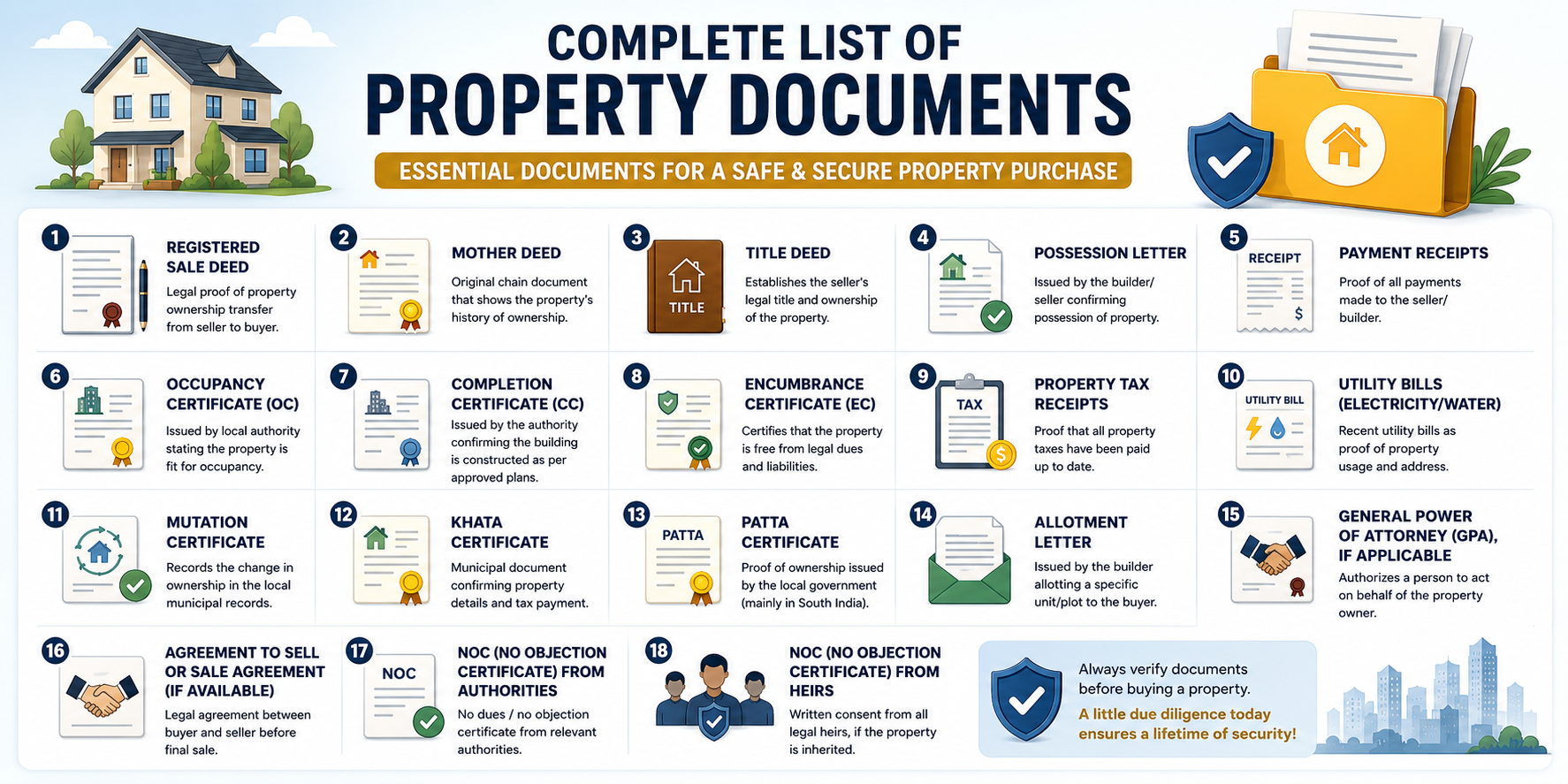
    To prove property ownership in India, you require essential legal documents like the Registered Sale Deed, Mother Deed, Title Deed, Occupancy Certificate, Encumbrance Certificate, and Mutation Certificate to ensure clear and lawful ownership, prevent disputes and verify compliance. Proper verification of these property documents safeguards buyers from legal, financial, and ownership-related risks.

    Here’s a list of documents in brief that you need to have in order to establish true ownership of the property.

    List of Legal  Documents Required For Property Ownership

    1. Registered Sale Deed

    One of the most important documents, the Sale Deed must be registered at a sub-registrar’s office. This legal document shows that the property ownership has been transferred from the seller to you (the current owner). Example: If you purchased a flat from Mr. Sharma, the registered sale deed with your name proves the transaction took place.  

    2. Mother Deed 

    Mother Deed is the second most important document, as it shows the complete history of property ownership, and thus called the “chain of title.” 

    A Mother Deed is the primary document that establishes the ownership of a property and traces the entire chain of title back to the original owner. It’s essentially the root deed that serves as proof of ownership for all subsequent transactions. For example, if someone sells a property, the transaction is recorded on the mother deed, which will then be updated in the title deed. 

    3. Title Deed 

    A Title Deed, on the other hand, is the document that proves the current ownership of a property. It reflects the latest transfer or sale of the property and is often used in legal or financial transactions. For example, when you buy a house, the title deed will show you as the legal owner.

    In short, the Mother Deed is the foundational document of property ownership, while the Title Deed confirms the current legal owner.

    4. Possession Letter

    Issued by the builder or previous owner, this document confirms that you have taken physical possession of the property. Example: In a new apartment, the builder hands over a possession letter once construction is complete.

    5. Payment Receipts

    It probes that you’ve paid the full consideration amount for the property. Bank transfers, cheques, or builder-issued receipts all count as evidence and helps avoid disputes over partial or fake payments.

    6. Occupancy Certificate (OC)

    Issued by the local municipal authority, this certifies that the building is ready for occupation and complies with all construction norms. Especially, if you buy a flat in a high-rise, an OC proves the structure is legally approved for living.

    7. Completion Certificate (CC)

    CC or the Completion Certificate is Issued by the municipal authority. This document confirms that the property or building has been completed as per the approved building plan. Without it, the structure may be considered unauthorized.

    8. Encumbrance Certificate (EC)

    This document confirms that the property is free from any legal or financial liabilities like unpaid loans, mortgages, or court cases. Before buying a flat or house, getting an EC ensures it’s not pledged as collateral to a bank.

    9. Property Tax Receipts

    These confirm that all taxes related to the property have been paid up to date by the current or previous owner. It also helps establish a clear legal and municipal record.

    10. Utility Bills (Electricity/Water)

    Bills in your name serve as practical evidence of possession and usage. Regular payment history supports claims of actual ownership.

    11. Mutation Certificate

    Issued by the local municipal body or revenue department, this records the change of ownership in local land or property records. Essential for paying property taxes in your name.

    12. Khata Certificate

    A Khata Certificate is issued by the local municipal body and records the property details in the city’s revenue records. It is essential for paying property tax, obtaining building permits, or for selling the property. Without a Khata, you can’t prove that your property is officially recognized by the municipal authority.

    13: Patta Certificate 

    A Patta is a land ownership record issued by the revenue department. It contains details like the owner’s name, survey number, subdivision, and area of land. It’s crucial for proving lawful ownership of land, especially in rural or semi-urban areas. For agricultural or vacant land, Patta is often the most important document. It distinguishes between government land and private land and helps avoid encroachment or legal issues.

    14. Allotment Letter 

    Issued by the housing board, builder, or development authority showing initial allocation to the first owner. Important in cases of flats bought in housing schemes like DDA or MHADA.

    15. General Power of Attorney (GPA), If Applicable

    If the property was purchased through a representative, the GPA must be registered and valid. It is not a substitute for sale deed but adds legal context to transactions done through an agent.

    16. Agreement to Sell or Sale Agreement (if available)

    This document outlines the terms and conditions agreed upon before executing the sale deed. It proves helpful in establishing buyer-seller intent, protecting buyers against fraud.

    17. NOC (No Objection Certificate) from Authorities

    NOCs may be required from the housing society, builder, or government departments (like fire, water, or environment) depending on the nature of the property.

    18: NOC (No Objection Certificate) from Heirs 

    A No Objection Certificate (NOC) from legal heirs is essential when a property owner passes away without a will. It confirms that all rightful heirs consent to the transfer, ensuring the buyer faces no future disputes or claims. This document helps establish clear ownership, simplifies registration, and protects the buyer from legal or financial complications down the line.

    If you are struggling to get these documents, consider taking help from a legal advisor. However, if you want to buy an apartment in Gurgaon, where you can get complete assistance during the home-buying process, then visit Inframantra. One of the best Proptech Advisory Firm in Gurgaon, Inframantra offers best deals on premium properties across the prime locations of the city with top-notch homebuying services without any brokerage. So, what are you waiting for? Connect with Inframantra and book priority site visits now. 

    You may also like to read

    Why Property Registry Is Not Enough to Prove Ownership in India?

    9 Things to Check Before Buying An under-construction Property in India

    Alka Gurung
    Written by

    Alka Gurung

    SEO Content Writer

    Alka Gurung is an SEO Content Writer at INFRAMANTRA, with 15 years of experience in content writing across real estate and other industries. She specialises in covering Gurgaon’s real estate market, luxury residential projects, and practical guides for homebuyers and investors. Her expertise lies in turning market data and on-ground insights into clear, informative, and useful content that helps readers make confident property decisions.